Friday, 25 April 2014

St George & the dragon, the roses and the books (Sant Jordi y el dragón, las rosas y los libros)...


This Wednesday (April 23) was all about roses and books here in Cataluña. It was La Diada de Sant Jordi (St George´s Day). The day of love (hence the roses) and Catalan culture (the books).

If you’re anything like me, you might only connect Saint George with England. But he´s actually the patron saint of many places and has been an important part of Catalan identity since at least the 14th century. The shimmering roof of Casa Batlló, one of Antoni Gaudí´s masterpieces on the Passeig de Gracia, actually represents the dragon from the legend of "Saint George and the Dragon".

Casa Batlló. The scaly, shimmering roof represents St George's dragon

Saint George and the Dragon

I was reminded that it was La Diada de Sant Jordi the moment I stepped outside my building as there was a little stall selling roses right there. Walking into the centre (my barrio is about a 15 minute stroll to Plaça Cataluña), I passed a rose stall on just about every corner (although I do have to say that some gave me the distinct impression that they may be flogging roses that had fallen off the back of a truck).


These roses I'm sure did NOT fall off the back of a truck...

But the real action was in town. Barcelona’s famous Rambla, along with The Rambla de Cataluña and the Passeig de Gracia were crammed with stall-after-stall, wrapped in Catalan flags (with varying degrees of love and care) and piled high with books or roses or both. And people. More people than I had ever seen on these streets – it took me half an hour to just walk a few blocks!


There was a very impressive number of book signings going on, a rose market in the Plaça de San Jaume and the beautiful Palace of the Generalitat (the Catalan government) was open to the public. In Plaça Cataluña, local Catalan-speaking TV stations were broadcasting live, along with Catalan radio and even Spain’s national broadcaster.

I eventually bought my rose from a stall set up by a local school. I saw others being run by bookstores and florists (obviously), clothes stores, toy stores (selling dragons, castles and Saint Georges), car dealerships, hotels, charities, animal welfare groups (including one of my favourites: SOS Greyhounds), LGBTI groups, political parties and, of course, the various Catalan independence groups.


Saint Jordi is not exactly a day for Catalan nationalism (that's La Diada Nacional de Cataluña on September 11), but with the current Catalan independence push, there was clearly an air of nationalism mixed in with all the roses and books. 

A referendum on Independence has been scheduled for the coming 9th of November. The central government has branded the referendum illegal, pledging that it won’t go ahead, but the Generalitat (currently an interesting coalition of conservative and left-wing nationalist parties) is pushing on. And so the Independistas were out in force on Wednesday, collecting signatures in support of the referendum and pushing the "Si + Si" ("yes + yes") campaign for the two questions: "Do you want Catalonia to become a State?" and in case of an affirmative response, "Do you want this State to be independent?"

"Say what Spain may, Referendum!"

If the referendum goes ahead (and that is a big "if") and the "Si + Si" campaign wins, this might have been my first and last Diada de Sant Jordi as a resident of Barcelona. You see, G and I are here as Italian citizens (my dad was Italian and G is Italian-Italian) and according to Spain and Europe, Cataluña will be kicked out of the EU if it chooses to go it alone, which could leave the huge number of resident ex-pats here from other EU countries in a bit of a limbo.

Best not to think about that for now and just smell the roses…


Sunday, 13 April 2014

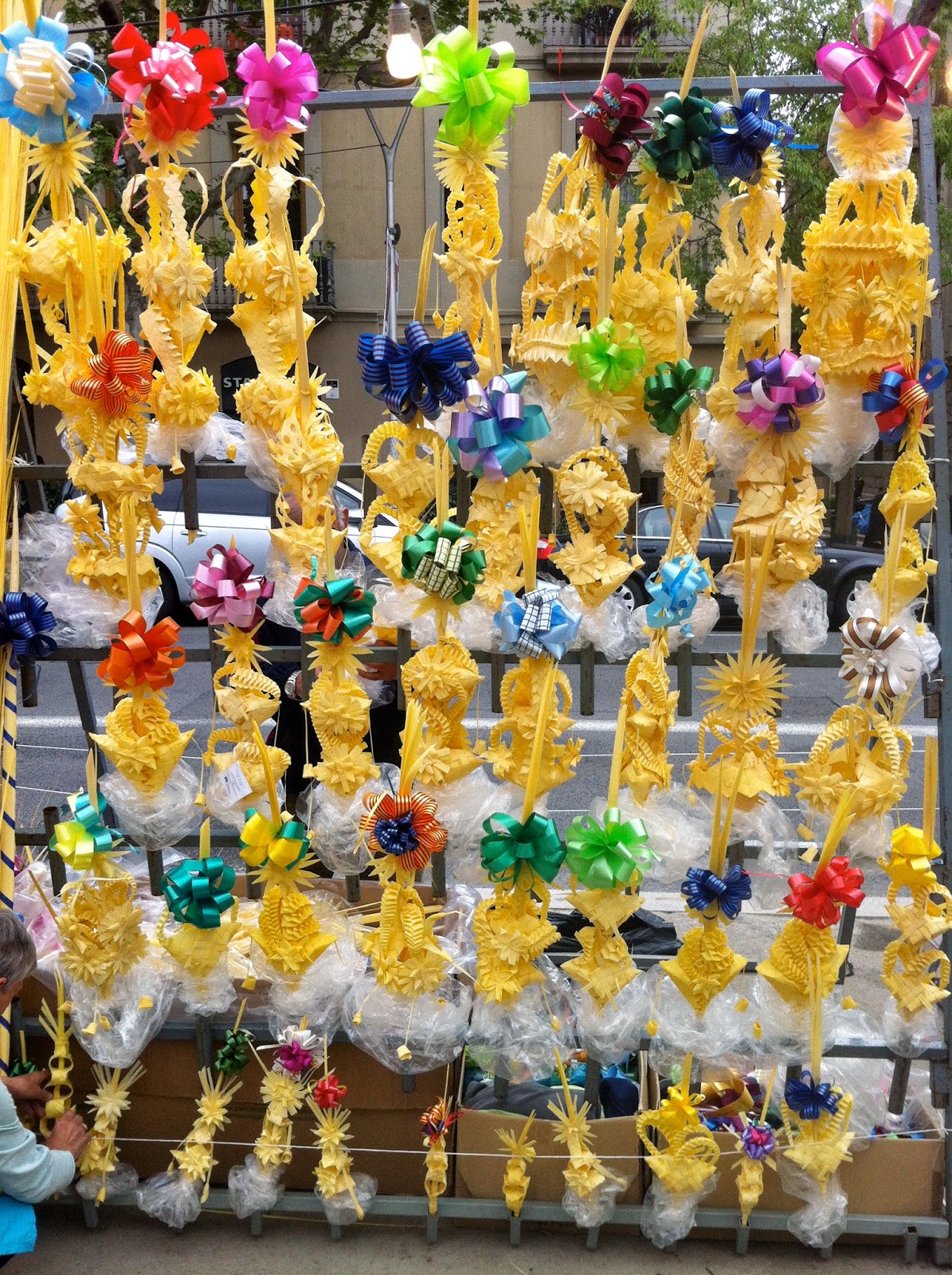
Palmones and other curious Catalan traditions (Palmónes y otras tradiciones catalanes curiosos)…


These are Palmónes. They look like sticks wrapped up with ribbon at first sight, but they are actually palm fronds – hence their name, which translates literally into “big palms”. They’re an Easter tradition here in Cataluña, and another one of the curiosities I need to add to my list of things I never saw in Madrid – like Cannelloni for Christmas and the Caganer (which I’ll get to in a minute as I cannot let that one go by without a mention).

It’s Domingo de Ramos (Palm Sunday) today, so the Palmónes are having their day. In Madrid, the (mainly) old ladies will be carrying their more regular palm fronds, minus the elaborate ribbons, home from church to tie onto their balconies.

Here in Cataluña, the Palmónes are the ambit of the kids – specifically the boys. The girls carry smaller, intricately woven versions called Palmas.  Traditionally, it’s the godparents who buy these, but I’m not sure how strictly that is being adhered to as at the Palmónes stalls just around the corner from home I saw what looked like Mums and Dads with their (excited) kids buying them together. I imagine the kids were more excited by the toys and sweets tied to them than any religious or traditional significances.

The intricately woven Palmas, for the girls

These days they use all manner of ribbons on the Palmónes and Palmas – like the Barcelona Football Club ones in the pic at the top. Traditionally though, the ribbons are in the design of the Catalan flag (red and yellow stripes).

A further Palm Sunday tradition is the donning of new clothes. If I’m honest, I can’t say whether this is the same in Madrid as I never came across it there, but here the saying goes that if you don’t wear some new clothes, your hands will fall off(!) Why exactly that is, I’ve not been able to work out…

Now, for that quick note on the Caganer – perhaps the oddest tradition I’ve come across to date. This is a figurine of someone... er... pooing. I’m serious; Cagar in Catalan means to have a poo. It’s not for Easter, but Christmas and you’re meant to pop one in a discrete corner of your nativity scene.

Traditionally they are classic Catalan peasant figures wearing a little red cap, but these days you will find all manner of characters – I’ve seen Bart Simpson, C3P0, Superman, Barack Obama, the list goes on – and all of them are squatting down and having a poo (with pile of poo included!). The true meaning of the Caganer is a bit lost, but many people say it has to do with fertilising the ground to bring prosperity for the year ahead. Whatever the reason, it’s a very curios Christmas tradition…

A traditional Caganer, pile of poo and all. Photo by Mtiedemann 

Wednesday, 9 April 2014

A ninth-century night out of town (Una noche fuera en el siglo nueve)...


The other week, G and I took a short trip out of Barcelona to spend the night in a 9th century castle. Well, the oldest part is 9th century, the rest having been added to, changed, destroyed and rebuilt over the years. Still, pretty awesome to think that we were sharing the same space where people had been living, working, flighting, held prisoner and even tortured (seriously, the anti-room to the current restaurant was actually used as a torture-chamber) over the past thousand years.


Of course to G it’s not such a big deal. He’s from Florence, so grew up surrounded by medieval wonder. But for me, coming from a country in which you’d be lucky to find a building standing that is 200 years old, it’s a thrill - even after all these years living in Europe. Not that G is a spoil-sport, he lets me ramble on about how “amazing” it is to think about all the people who had been standing in this spot or that over this century or that, feigning interest as best as he can. God bless him.


Anyway, it’s called Cardona Castle and is about an hour-drive north-west of Barcelona, in the foothills of the Pyrenees. The setting is pretty spectacular. The castle looks very imposing set up high on a steep hill overlooking the town of Cardona. From one side of the castle there are views up to the snow-capped peaks of the Pyrenees and from the other, to the jagged rock crown of Montserrat. Just behind the town you can see the reason why Cardona was once so important as to deserve a castle like this: a massive salt mountain.


Salt is still being dug out from the Cardona mine, as it has been since even before the Roman’s got there. A tour through the mine is meant to be well worth it, according to TripAdvisor. Unfortunately I didn’t read this until after we got there and we chose to visit on the only day (Monday) that the mine was closed.


There is another reason why Cardona has such an imposing castle. It used to be right on the border with Al-Andalus - Moorish Spain - so it was important for both keeping the Moors back and as a base for incursions into Moorish territory in attempts to claw it back for Christendom.  Also, being so close to France, it was important for keeping out invaders from the north. Legend has it that it was assailed a thousand times and never fell.

The mine and the castle are said to be the main things to do in Cardona, but I think a walk around the medieval town centre is essential too. It won’t take long, it’s small and when we were there at least, there was very little going on. But its narrow, hilly streets, ancient buildings and stone and wooden archways are enchanting.


There is a beautiful, austere 13th century Gothic church there too. It’s greatest treasures were a little hidden from us though as, as so happens in Spanish churches, they are tucked away in dark corners that require a Euro to be inserted into the light switch to allow you to enjoy them – and we walked into the church without a single coin between us.


The castle is these days a Parador hotel. The Paradores is a state-owned network of hotels, a great many of which occupy grand old buildings that form part of Spain’s national heritage. They were started by King Alfonso XIII (Spain's last king before the Second Republic). The idea was that by restoring these buildings and turning them into hotels they could help pay for their own upkeep, both saving them and breathing life into the Spanish countryside via tourism.


If I’m honest, I find the Paradores a little bit stuck in the 70s in terms of their offerings and styling, but the magnificent buildings that many of them are housed in I think makes us for this failing. The Spanish government is currently in the process of selling the Paradores off. This will probably update the offering, I just hope some pretty strict clauses are included for maintaining their important heritage role.

Saturday, 29 March 2014

Farewell to “the leader who changed the history of Spain" (Adiós al “líder que cambió la historia de España” )…


Spain has been in mourning this week.  Adolfo Suárez González, the first democratically elected Presidente del Gobierno (Prime Minister) after Franco’s dictatorship, died on Sunday (March 23).

Suárez was Prime Minister from 1977 until 1981, as Spain transitioned from dictatorship to democracy – what the Spanish call simply "La Transición" (The Transition).

Now, and this is probably something you'll hear from time-to-time in this blog, it completely blows me away that the country in which I am living has been a democracy for only 37 years.

I’m sure that’s because I come from a country that has only ever known democracy (at least for its non-indigenous citizens), which probably makes me a little naive. And my Eastern European friends will remind me that their democracies are even younger. But that still doesn’t dull my fascination and (even) awe.

There are some aspects of Spain that I wonder might be signs that the democracy is still young(ish). Corruption, that so flourished during the dictatorship, is still rife in the political and business worlds (although the country been getting a better handle over it just in the years that I’ve lived here); the virtually undisguised disdain which many of the powerful still hold towards ordinary people; the influence that the Church blatantly still tries to wield and the strikingly authoritarian views that often appear in the conservative media (some of the worst offenders being TV and radio stations owned by these same Bishops), are some examples.

But there are positives too. One, for me, is the fervour with which the Spanish protect their rights and freedoms. Perhaps this is because there are so many people still alive who remember living without them. I think that in some slightly older democracies, like my own, we take these rights so for granted that we can sleepwalk into them being eroded.

Spaniards on the other hand, are very quick to recognise a threat and organise themselves to fight it – often into massive movements. I’ve mentioned before the astounding number of manifestaciónes (demonstrations) that have been held in Spain since the economic crisis hit - 25,461 just last year!  And whilst it is true that most of these have their roots in the economy, many people think the measures being taken to combat the crisis are also leading to an erosion of their rights and freedoms.

There have been the mareas ciudadanes (citizens' tides) of varying colours (white for health, green for education, violet for women’s rights), movements for better democracy have camped out for months in Madrid’s central Puerta de Sol square and people have marched from all points of the country to converge into macro-manifestaciónes in the capital.

The sheer number, participation, energy, variety and (in the vast majority of cases) peaceful and festive natures of these demonstrations have been truly awe-inspiring to me, as an extranjero. Things did get very ugly just the other day though: 67 police and 34 protesters were injured when violence broke out at the end of a demonstration, in scenes like nothing I had ever seen in all the demonstrations I witnessed whilst living in Madrid (and I saw a lot of them). I hope it's not a sign of things to come…

Regardless of whether I’m right to (perhaps cheekily, or worse) suggest that these are signs of Spain’s democracy being “young”, there is no denying it is strong and modern – something that most Spaniards are very proud of.

And that takes us back to Adolfo Suárez. Just about everyone I’ve heard talk of him this week, including ordinary Spaniards, interviewed as they waited in a two and-a-half km queue for their turn to file past his coffin, agree that the road to Spain’s democracy might have been very different without Suarez and his ability to both find consensus and persuade during the very tricky time that was La Transición.

And it is for this, much more than simply being the first democratically elected PM, that Suárez was farewelled with such honours. The title of this post I’ve taken from a newspaper headline and sums up perfectly how Spain sees Adolfo Suarez: he was the man who changed the history of the country. And just 37 years ago(!)

Saturday, 22 March 2014

Why I got hooked on Madrid (Por qué Madrid me enganchó)…


A while back I mentioned that my initial plan was to move to Barcelona “until I discovered Madrid”. Well, here is why that is.

I was very lucky on my first trip to Madrid – it coincided with “La Paloma” (The Dove).  La Paloma is a magical time in Madrid, when the streets of the central barrio (neighbourhood) of La Latina cram full of families, young people, old people, Chulapas and Chulapos (see below), bewildered but delighted tourists – everyone. Its roots are religious, La Paloma is a sort of patron saint of the city, but as so often happens in Madrid and Spain, the religious and the social swirl together into a whirlwind of colour, dancing, food, drink and general fun.

Chulapas & Chulapos

There is a procession: the portrait of La Virgen (the Madonna) of La Paloma is carried on high from the church where she hangs during the rest of the year, through the streets of the barrio, accompanied by the woodwind and percussion bands that mark most religious processions and led by Madrid’s bomberos (firemen) of whom she is the (unofficial) patron.  But this procession is just a couple of hours bookended by a couple of days of other festivities.

La Paloma's portrait being carried through La Latina

La Paloma represents so much of what Madrid is, and why it enchanted (and still enchants) me. Everything is full to over-flowing: the narrow streets, the typically tiny bars, the tables and chairs crammed into the squares. The noise is thunderous: patrons yelling orders at the barmen, punters in bars or in the street singing along at the top of their voices to traditional songs or trashy Spanish pop, DJs blaring tunes out into the street from the younger (or gayer) watering holes.

La Latina's streets crammed with La Paloma revellers

Madrileños are most comfortable when outdoors and in throngs. Even the solemn and haunting processions of Semana Santa (Holy Week) are massive, although strangely - eerily - quiet, affairs. Madrileños attend these processions in their thousands, year after year, to catch a glimpse of their favourite Virgen or Jesús (Jesus) pass by them, held high on staggeringly elaborate alters.

One of Madrid's many Virgens in procession during Samana Santa

The rather creepy-looking Nazarenos during Semana Santa

Being smack-bang in the middle of the country, there’s no seaside to congregate along, like in Barcelona, so in Madrid it is all about the street (or local square). And especially at night.

There is a wonderful scene at the end of Almodóvar’s film “Carne Trémula” (“Live Flesh”), where Victor, stuck in traffic and trying to get his girlfriend to hospital to dar a luz (give birth – literally “give light to”), attempts to distract his son-to-be from arriving in the taxi, by telling him about the Madrid of his birth, also on the way to hospital, at night, back in the days of the dictatorship:

“Look at the footpath full of people. When I was born, there wasn’t a soul in the street. The people were shut up in their houses, scared shitless. Fortunately for you my son, in Spain, we stopped being scared a long time ago.”

Maybe this has something to do with Madrid’s liveliness; maybe the Madrileños are making up for the 40 years they lost whilst being forced to deny their nature. Whatever the reason, these teeming nighttime streets fascinated and thrilled me from the start.  

Different urban “tribes” do favour particular barrios over others, but the segregation never feels as complete as in some other places. Perhaps it’s because the barrios are pretty close to each other, so people tend to spill from one into the other. Also, all are still home to their vecinos de toda la vida (residents who have lived there all their lives) who share their streets, squares and even bars with their new(ish) neighbours.

But if I had to generalise, the barrio demographics go like this:  Chueca for your gays, Malasaña your Hipsters (or as we call them in Spain, “Modernos”), around Sol and in Las Letras your tourists and Lavapies, an amazing mix of many: your grungier, arty/designer-types, Muslim immigrants (it was here, in the locotorios  (internet and long distance phone-call shops), cafes and curry houses that the 11-M bombings were planned), Chinese fashion wholesalers and your young gays, who have begun moving here as Chueca has got too expensive. Some friends of mine visiting from Australia a while back got themselves “lost” in Lavapies, emerging some time later in possession of some of Morocco’s rather prized export…

Chueca during Orgullo (Gay Pride)

Vecinas de toda la vida in Malasaña

And then back to La Latina. This is one of Madrid’s oldest areas - the buildings lining the narrow Cava Baja street are built on the foundations of Madrid’s ancient Moorish city wall. It rocks during Madrid’s most important festivals (like La Paloma) but the rest of the time, it’s the place to be on a Sunday afternoon, when it’s myriad tapas bars fill to overflowing with all manner of Madrileños, looking to soak up the last hours of the weekend.

Here we are again at the Madrileños love of sharing experiences. There's a timetable to living in Madrid: Saturday afternoon is un paseo (a walk) through Sol and the central shopping district, Saturday night Chueca, Malasaña or Lavapies, Sunday morning “El Rastro”, a massive flea market that has been going on forever, and Sunday afternoon, the tapas bars of La Latina. These traditions feel rather small-town-in-the-big-city (more than 4 million people live in Madrid). And it's nice. You always know where you can find the crowds, if you're in the mood.

There’s so much more to tell about life in Madrid, but it’ll have to wait for another time. For now, I hope I’ve given you a little taste of why Madrid me enganchó (hooked me) and has never has let go, even though I’ve left there… for now. 

Friday, 14 March 2014

The Madrid bombings, ten years on (Diez años despues del 11-M)...


This week, on the 11th of March, we marked the 10th anniversary of Spain’s worst-ever terrorist attack. On the eve of that anniversary, something happened that hasn’t been seen in this country since 2007: all the main Victims of Terrorism groups stood together in an act of remembrance of that terrible day.

It seems unbelievable that this could be the case; that such an atrocity didn’t unite the country as it did the United States after September 11. Of course, in the beginning it did, but it didn’t take long for politics to pollute things. 

On that crisp morning of March 11, 2004, fundamentalist Islamic terrorists left 13 backpacks chock-full of explosives on four of Madrid’s suburban trains (Cercanías). Using the clocks in mobile phones, the bombs were timed to go off within minutes of each other during the hora punta (rush hour). The result was 191 passengers killed and more than 1800 injured.

I wasn’t living in Madrid at the time, but I can understand the disbelief, pain and fear the Madrileños would have suffered that day. I was a London resident when, just a little over a year later, its transport system was attacked and its people killed.

The day after the attack, more than two million Madrileños braved the pouring rain to take to the streets in both homage to the victims and to furiously demand an end to terrorism in their country. Similar marches were held all over the country. The solidarity and dignity visible in the images of Madrid’s main thoroughfares filled to overflowing in a sea of umbrellas and banners are both impressive and very moving.

But the attacks took place just three days out from a general election. Up until 11-M, as the Spanish call both this day and the attacks, the incumbent government of the conservative Partido Popular (People’s Party - PP) was ahead of the opposition Socialist Party in almost all the polls.

The government’s immediate conclusion, and that of just about everyone else, put the blame squarely on the shoulders of the Basque terrorist group ETA. It made sense; ETA terror had cost the lives of more than 800 people in Spain during their 30-odd years (at the time) of violent activity.

Very quickly however, literally in a matter of hours, doubts began to arise in the minds of police, security forces, terrorism experts and journalists - militant Islam started to look like a possible culprit. But the government steadfastly refused to accept that ETA was not the perpetrator and in press conference-after-press conference, press release-after-press release, it insisted ETA was to blame.

The opposition seized on this refusal in the face of the mounting evidence. Soon people were demonstrating in the streets demanding to know “¿Quien ha sido?” (“Who was it?”). And of course, the connection was made between the government’s (highly unpopular) robust support for the Iraq War and the attacks.

Whether it was the Iraq connection or the fact that the government’s belligerent denial of what was seemingly becoming undeniable led people to feel it was trying to hoodwink them, come election-day the Aznar government was swept from power.

The political lines had been drawn right through the middle of the atrocity. The Right accused the Left of using Iraq to blame the government for the terrorist attacks in order to win the election. The Left accused the Right of refusing to accept fundamentalist Islamic terrorism as the culprit because ETA was more politically advantageous. Even worse would come later.

Just over two weeks after the attacks, seven of the terrorists (all Islamists) blew themselves up in a flat in the south of Madrid when cornered by the police and security forces. Three years later, Spain's Audencia Nacional (National High Court) determined the attacks to be the work of fundamentalist Islamists and convicted 21 people. It found no evidence of the involvement of ETA or of other conspiracies.

But Aznar and some other members of the PP have never stopped insisting on ETA’s authorship of the attacks,that they had worked together with the Islamists. Another far more sinister conspiracy theory that emerged is that the attacks were in fact a Socialists coup aimed at winning the general election and that police, security forces, intelligence agencies, judges, prosecutors, witnesses and others were involved.

The attacks by the conservative media supporting these conspiracy theories were so voracious that they have been accused of costing lives. One was the wife of a local councillor who was involved in the collection of personal belongings from the train attacked in his district.

One of the backpacks collected actually contained an unexploded bomb from the attack - the phone inside of which would lead police straight to the terrorists in that flat in Madrid's south. His credibility was attacked with such viciousness that his wife committed suicide. Another was the owner of a bar who refused to put up a flyer supporting the ETA connection. He was shot dead by the person who had wanted to put up the flyer.

The politicisation of 11-M infected the different Victims of Terrorism groups, some siding with some level of conspiracy theory and others accepting the official findings. The sad result has been that over the last 10 years, on the anniversary of the attacks, separate memorials have been held by the different victims' groups, with members of the different political parties attending different memorials.

That is why those four ladies standing together at Monday’s memorial service was so significant. Perhaps it was a sign that, ten years on, the worst of politics is starting to retreat from the 11-M, giving some space for Madrid and Spain to grieve and heal in peace and dignity. I just find it a shame that it was those who have suffered the most who had to take the first steps. 

Friday, 7 March 2014

Shopping Trolley (Carrito)


This is my carrito (shopping trolley). I'm a big fan.

Of course in Australia (or the UK) I wouldn't have been seen dead with one. There, shopping trolleys are strictly for old ladies. And having said that, my Mum, who would kill me if were to reveal her precise age so I'll just I say you'd find a Seniors' Card if you went rummaging though her purse, still steadfastly refuses to invest in one.

Here in Spain though, it seems just about everyone has one. And they're brilliant.

I use mine especially for a trip to the mercado (market) - and by that I mean the real market, not the SUPERmarket.

I didn't go to the market much when I lived in Madrid. You need to invest a good whack of time to shop there, you see, and I was always too busy. But here in BCN I've had a little more time on my hands.

A trip to the market starts off with a few laps to compare the produce at the different puestos (stalls). If you're new to a market it’s a good idea to use these laps check out which stalls have the most people waiting at them as they're likely to have the best stuff.

Once you've chosen your stall, you need to find your place in the "queue". There's a definite etiquette to this. You must announce your arrival (and your intention not to jump the queue) by clearly asking "¿Quien es la ultima?" ("Who is last in line?").

It's likely you've already worked that out though as that very person will be looking at you with a glare that silently but succinctly says "I'm before you, right?!" This look will not dissolve into a smile until you've asked the question and received the reply "Yo" (me).

¿Quien es la ultima?

This process never fails to give me a chuckle, but it's catching. These days I find myself shooting that same look to whoever joins the throng directly after me as I too wait to hear the reassuring question.

Secure in the knowledge of who is before and who is after you, there's nothing much to do now but wait and then wait some more.

At the carnicería (butcher), it seems everyone has their own particular idea on how they want their meat cut. At the quesería (cheese stall) it’s almost obligatory to try a little of this one or a little of that one before making up one’s mind. And there’s still the frutería (greengrocer) and the charcutería (cold meats stall) to go. Then, for each, you need to factor in time for a quick chat about recent events, the weather or how the grandkids are doing.

Yes, that’s right, the grandkids. You see, generally (and this is where we come back to old ladies), it's me and the abuelas - literally "grandmothers" - at the market.

Not that I mind. I like being amongst the abuelas. You sort of become the centre of attention: a young(ish) MAN shopping at the market is a little novel. Add my thick accent to the mix, and you’ve got a conversation.