Showing posts with label architecture. Show all posts

Thursday, 13 August 2015

Living in l'Eixample

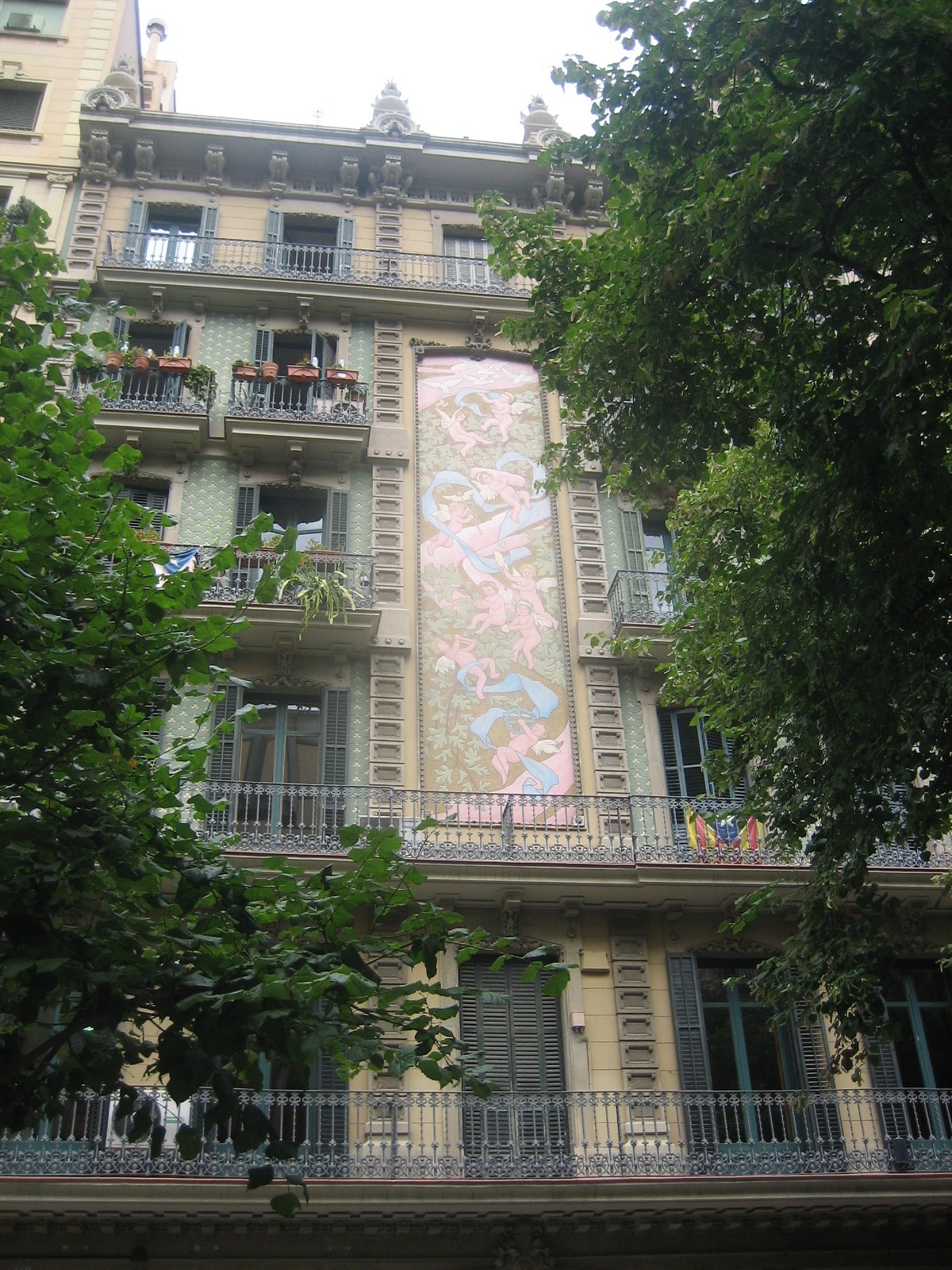
My building. There Those flags hanging from the 3rd set of balconies are for Catalán independence

This is my building and those three Juliette-type balconies on the top floor there, that’s my flat. Sadly the building is not one of Gaudi’s creations, but it certainly has modernista (art nouveau) touches. I think it’s rather pretty.

Barcelona is renowned for it’s modernista architecture so I feel quite privileged to live in a building that somewhat lives up to that reputation. Here are a few other nearby examples:


This part of the city is called The Eixample – pronounced like “eshampla”. It’s a Catalán word meaning “widening” or “extension”, which is exactly what the area was when they built it in the late 1800s and early 1900s – an extension or widening of Barcelona.

It filled in the gap between the existing city and surrounding towns, like Gràcia towards the mountains - which is why the famous shopping street Passeig de Gràcia (Gràcia Passage) is called what it is - or Sants to the south.

Of course over time, with the building of the Eixample these towns became incorporated into Barcelona itself – Sants is home to Barcelona’s main railway station – but you can still tell quite clearly that they were once separate: the Eixample’s art nouveau architecture and its distinctive road layout makes it pretty obvious when you enter or leave it.


The Eixample’s roads are long and straight and in a grid formation, very different from much of the rest of the city. But the most distinctive feature of the area is its octagonal city blocks. This means each intersection is octagonal also – a fact that completely infuriates a dear friend of mine when he visits from Madrid, for the extra walking it creates to cross each intersection.

The Eixample's grid is very obvious from the air

Closer up, the distinctive octagonal blocks stand out. You can also clearly see where the Eixample starts and stops. 
That's Gràcia on the right-hand side. Image by Alhzeiia (http://www.flickr.com/photos/ilak/3187655762/) [CC BY-SA 2.0 (http://creativecommons.org/licenses/by-sa/2.0)], via Wikimedia Commons.

But despite what my friend thinks, this design is not just to annoy him. There was method to, Idelfons Cerdà’s design “madness”: extra visibility at intersections, light and air-flow.

One of the most impressive elements of this design you can’t actually see from the street. Cerdà’s small blocks and the fact that the buildings that line them don’t go back too deep means that a big open space is created on the inside of each block. This means that even from the back of the building, plenty of light and airflow gets into your flat.

The interior view from my flat. Shame the palm trees in the middle aren't doing too well

This is quite different to the older parts of town or Madrid for that matter. There, your view from the interior of the building is often a light-well! In the centre of Madrid, where many of the big older flats have been split up into two or even three smaller ones, some of which are completely interior-facing, you can be left with very little light and absolutely no view (apart from your neighbours, of course).

These days Cerdà, the art nouveau buildings that abound in the area he designed – along with their architects, like Guadì, but many more too - and the Eixample itself have all become, quite rightly, treasures of Catalán culture and sources of pride. And the Eixample’s distinctive layout has become something of a symbol for the whole city.

The modernista Sant Pau hospital complex. Apparently it's the biggest art nouveau area in Europe. It's quite beautiful

Of course one drawback to the grid-layout, and one that Cerdà probably wasn’t thinking about in the late 1800s, is modern-day traffic. On my particular octagonal corner of the Eixample there’s a hell of a lot of it.

Now traffic noise you tend to get used to, and we have, but I do wonder just how much of that traffic I’m breathing in when I sit inside with the balcony doors open, enjoying that breeze that Cerdà had in mind with his design. If the dusting that’s required in this flat is anything to go by: a lot.

And then there are the ambulances. But I’ll let my dog Eddy tell you about that in his own words, in the video below:


But hey, that’s life in the city, no?

Friday, 1 August 2014

Feeling privileged (Me siento privilegiado)...

The Sydney Opera House

Being a Sydney boy, I’ve always felt privileged to hail from a city that can boast a building as wonderful, iconic and unique as the Sydney Opera House. I remember always doing my best to take the bridge rather than the tunnel as I crossed the harbour on the way to work each day, just to get a glimpse of it.

Of course during the last 15 years, I’ve only had the opportunity to lay eyes on ‎Jørn Utzon’s masterpiece once in a while and then only as a visitor to Sydney-town, which always left me feeling a little wanting – I suppose removed.

But now that I am a resident of Barcelona, that privileged feeling has returned.You see, I’m lucky enough to get to see Antoni Gaudí’s Sagrada Família church just about every day, usually as I walk the dog through the two parks on either side of it.


I’m not exactly sure if I’ve yet worked out just what grabs about it: it’s impressive bulk, that somehow makes it look tall and squat at the same time; the schizophrenia of the styles of the two main facades – the gothic and naturalist of the “Nativity” or the angular and austere of the “Passion” (it's probably a little controversial to say this, but the Passion is my favorite – there’s just too much on the Nativity side for me to take in); the wonderful ceramic “fruit-bowls” that adorn the sharp peaks of the buttress; the glimmering tiles that clad the spires, the lizards and snakes clinging to the outside walls of the radiating chapel; or the simple fact that just when you think you see a part of it that seems “cathedrally” conventional, you look again and see that it is anything but.


The Passion facade - my favourite

The "fruit bowls"

The glimmering towers

The lizards and snakes clinging to the walls

Not that everyone is a fan of the Sagrada Família. A very good friend of mine visiting from Madrid told me in no uncertain terms that he didn’t like anything about it. And others, perhaps more versed in art and architecture than him have labeled it vulgar, pretentious, a circus attraction, even “the most blatant mass of half-digested moderniste clichés”. Even Cataluña-loving George Orwell, having seen the building while he was fighting with the International Brigades during the Spanish Civil War, called it “one of the most hideous buildings in all the world”.

I do get why it is polarizing (I think my description above of what I like it is explanation enough of why others might not) but I have to say I fall firmly on the side of those who love it. And then there is the inside.

If you’re ever in Barcelona and tempted to be satisfied with viewing the Sagrada Família just from the outside, resist. Do yourself a favour, brave the crowds and go inside (book your entrance online so you won’t need to line up in a queue that sometimes just about wraps around the entire block).


A forest of geometric wonder

I only saw the inside for the first time a few months ago (it was still a building site when I first came to see it in 2000) and it made my jaw drop. The sheer height of the vaults (60 meters in parts), the imposing columns of sandstone, granite, basalt and porphyry, clearly reminiscent of a forest of giant trees complete with branches and the magnificent geometric detail of the ceiling are just some of the highlights for me.

I also love the back-story of the place: the important Modernista (Art Nouveau) outbuilding that was the school Gaudi built for the children of his workers; the way Gaudi captured the forms and flows of nature for his designs using shapes suspended with string and viewed in a mirror (you can clearly see the results of that in the design of the anterior); the fact that anarchists during the Spanish Civil War burned many of Gaudi’s designs and they had to be re-created via photographs and (later) computer-aided design; or, as an engineer friend of mine visiting from Australia explained to me not long ago, that Gaudi was so far ahead of his time that we’ve had to wait for engineering technology to catch up with some of his plans in order to actually build them!

So yes, I do feel very privileged to be able to enjoy this building every day, even if only for (or perhaps because of) the mundane reality that the dog needs to have a walk and do his business.  And I look forward to returning one day in or after 2026 to see it completed – although I imagine I’ll find it a little odd minus all the cranes that are the only way I’ve ever known it and that have become, for me, part of the building.


These days, for me at least, the cranes are part of the Sagrada Família

In the meantime, thanks to the wonder of computer animation, we can get a glimpse into that future. Check out the video below: