Showing posts with label cataluña. Show all posts

Sunday, 27 September 2015

It's Autumn, but things are heating up in Cataluña (Es otoño, pero se está calentando en Cataluña)...

This last week or so a definite chill has crept into the morning and evening air - we’ve clearly left the summer behind us here in Barcelona.

But at the same time the air temperature has been dropping, the political temperature has been going in the opposite direction.

Always proudly Catalan, the Sagrada Familia is draped with the Catalan flag (la Senyera) for La Diada

To start with we celebrated La Diada – Cataluña’s “national” day – on September 11. I can’t quite believe it’s a whole year since I last wrote about it.

For the past five years, La Diada has shifted from a celebration of Catalan nationalism to a show of people-power for Catalan independence. Many Catalans who are not independistas say that it has been “hijacked” by the independence movement.

And perhaps they’re right. This year’s slogan was Via lliure a la Rebública Catalana (Road to the Catalan Republic). The word Lluire is quite significant here as although it doesn’t make it into the expression’s English translation, it means “Free”.

My local sign-up and information stall for La Diada and voting for Catalan independence

Once again an emblematic Barcelona street (this year Av. Meridiana) was the setting for the hundreds of thousands, all dressed in the year’s “uniform”, to take part in the choreographed spectacular, which I’m pretty sure is designed much more for the external (outside Cataluña) audience than the internal.

Crowds celebrating la Diada. Rather impressive, no?
Pic by Teresa Roca, Assemblea.com. Creative Commons license

La Diada 2015. I think the arrow being run up the street symbolises moving forward to a new future.
Pic by Jordi Ventura i Plans, Assemblea.cat. Creative Commons license

Can't get much more Catalan than this: Castellers at La Diada, 2015.
Pic by Assemblea.cat. Creative Commons license

I ventured down amongst the throngs for a little while and was struck by two things. First was the crescendo of Catalan. Barcelona is such a tourist city that walking around its streets is normally like a trip to the Tower of Babel. Not that day. The young, the old, the groups of friends, the parents calling their children to attention, the punters ordering cervezas in the bars - it was all being performed in Catalan.

I’ve yet to work out whether this was because I am just not used to being in such a mob of Catalans undiluted by the usual foreigners, whether it had to do with the “national” pride of the day lending more people to converse in their “national” tongue (rather than Spanish), or whether the types of Catalans who would make the effort to take part in the La Diada are those most likely to speak Catalan all the time anyway. I suspect it’s probably a mix of all three.

The other thing that stood out to me was the plethora of Blue Estelada flags – little ones on sticks clutched in children’s hands, large ones on poles slung over shoulders (of pedestrians and scooter riders alike) or, personally something I find quite distasteful, being worn like a cape (I loath it when I see it done with the Australian Flag on Australia day too).

I am really NOT a fan of flags being worn like capes. To me, no matter where I see it, it smacks of a rabid nationalism

The interesting thing about so many Esteladas is that it is not even the Catalan flag. It’s the flag for Catalan independence; perhaps another point for those who subscribe to the hijacked Diada thesis.

The Estalada being flown from the Arc de Triomf. 
I was surprised to see that as the Arc de Triomf is a city monument as the Estalada is not an official flag

This year’s Diada was a sort of unofficial campaign kick-off for the other reason the political temperature is souring – it’s election-day for the Catalan parliament today.

The pro-independence parties have billed these elections as a plebiscite on independence, so much so that the two main ones (polar opposites on just about every else else) have joined with pro-independence community groups to form a unified ticket, Junts Pel Sí (roughly, “Together for It”). 

And they've promised to start the process to achieve independence from Spain if they get a big enough result. 

The non-independence parties claim that the independistas are deliberately deceiving the electorate by calling this regional parliamentary election a plebiscite on independence - something that is illegal under Spain’s constitution anyway, they argue.

The last few sondeos (opinion polls) are calling an absolute majority for the independence parties in Cataluña’s Parliament, but only just (although that “just” does get a little chunkier with each poll).

But at the same time, it looks like the voter turnout is going to be historically high and traditionally a higher voter turnout augurs better for the non-independistas.

It's going to be a nail-biting count-night for both sides tonight.

As an extranjero, not only in Spain but also in Cataluña, (or should I say Catalunya) I’m not sure I have a right to an opinion - I’m sure I don’t understand all the social and historical intricacies of the arguments.

But if I were to venture an opinion, and this probably has a lot to do with my first seven years in Spain being spent in Madrid, I don’t really like the idea of a broken-up Spain.

Having said that though, since I moved to Barcelona I haven't quite felt that I was living in the same Spain anyway.

***

If you’re interested, here are a few links in English that offer some insight into just how complex the situation really is:

From an ex Spanish Prime Minister to the Catalan Premier:

The Catalan Premier’s response:

Another Catalan politician’s (nationalist, but not independista) response to the ex-Prime Minister’s letter:


Wednesday, 8 April 2015

Flu! (¡Gripe!)…


Last month un gripe (the flu) took hold in our household. Now I’m not talking about your run-of-the-mill “man-flu” here; I haven’t been so sick for literally years. Within the space of just a few hours I went from feeling quite normal to being worried I was actually going to die. It was brutal.

Unfortunately, despite bringing the marauding microbe home, I wasn’t the worst effected. Poor G went down like a tonne of bricks a couple of days after me and ended up in hospital with pneumonia!

That was a hell of a shock. G is normally insanely healthy - he is never sick - but all of a sudden there he was laid-up in hospital in quite a precarious state. I’m not ashamed to admit that I was pretty scared.

Now that the concern has passed (although I can tell you, we’ll both be making sure we have flu shots each year from now on), I’ve been reflecting on the whole experience from the point of view of an extranjero experiencing hospital for the first time in Cataluña.

The treatment G got once he was in hospital was actually top-notch and we’ll both always be grateful for that. But the actual getting into hospital was another story.

In Spain, the Sanidad Pública (public health service) is run by the government of each Comunidad Autonomo (literally Autonomous Community, but best translated as “Region”). As I’ve mentioned before Cataluña has privatised much of theirs.

Our local heath centre is run by one of these private companies, which also runs a hospital just around the corner from the surgery. G ended up in that hospital after our local GP took one listen to his lungs and referred him straight there with a little note saying pneumonia was suspected.

Now I thought that with such a note he’d be taken straight into one of those urgencias (emergency-room) cubicles from where all necessary tests would be performed. Instead, what he endured was seven hours of being shunted from the rickety wooden benches of the waiting room (which was actually the drafty corridor of a building from the century-before-last) to each hospital department and back again to wait the hour or two for the results from each test.

When “one last” x-ray was suggested, “just to make sure”, I put my foot down. I told the doctor that G simply couldn’t be expected to spend another few hours in that corridor – what he needed was to be at home in bed. That’s when she told us that he’d not be going home that day, but instead would be ingresado (admitted to hospital).

What followed was a 20-odd hour wait (thankfully though, now in an emergency-room bed) for a bed on the ward. Urgencias is a pretty awful place to be trapped for the best part of a day and night. To make matters worse for G (and for me), I was only allowed to see him for about 10 minutes during those more than 20 hours.

Like I said, once he was in hospital he was really well looked after, and although the building certainly looked the 100-odd years it was, it seemed to have up-to-date equipment and facilities. I just couldn’t help being suspicious that things could have been better if the hospital hadn’t been run by a private, for-profit company.

Why did G have to spend so long in the emergency department when there was a huge, brand-spanking new hospital less than a kilometre up the road? Was it because that hospital was run by a different health provider and our hospital would not get the money from the Sanidad for his three days in hospital if they sent him up there?  

Of course, maybe all the hospitals were colapsado (overrun) that day. Maybe it was the result of the cuts to the health budget because of the crisis. Maybe it’s always been that way here in Cataluña.

Or maybe my “pinko-poofo” prejudice against privatising essential services was colouring my thinking. Indeed there have been plenty of news stories this winter of emergency departments in totally public-run hospitals in other Comunidades leaving people on gurneys in corridors for 30 hours or more.

But then again this is Cataluña, where for much of the last 30 years successive centre-right governments have been busy privatising public services more than anywhere else in Spain.

And despite the savings and efficiencies that privatisation is meant to provide, Cataluña is one of the Comunidades in which public service budget cuts during this crisis have been most acutely felt by its citizens and where, at the same time, public debt has grown more than just about any other.  It’s food for thought.

But credit where credit is due. Thanks to the care that G received once he was finally ingresado  he made a full recovery - and just in time for our wedding(!) But that’s a post for another day.

Thursday, 16 October 2014

A year in Barna already (Un año ya en Barna)


A year ago today we drove into a sunny, autumnal Barcelona, dog-in-tow, to start the next chapter of our lives. We were filled with mixed feelings. On the one hand, we were excited. This was the next big step for G in his career; we knew we were moving to a beautiful city; we were going to be living by the beach again; we already had some friends here waiting for us.

But on the other hand, just a day before we had said a sad goodbye to our friends and our life in Madrid. Seven years is more than enough time to develop meaningful relationships, both with people and places.

So how has this year been? Well if I’m honest, it’s been a little tough. Of course it’s never the same living somewhere as experiencing it as a tourist. But we knew that - it’s not the first (or the second) city we’ve moved to.

And it’s not like haven’t established a life here. We’ve embraced, with some relish, the substitution of Madrid’s (in)famous vida nocturna (night-life) for lovely Sunday lunches with friends on the beachfront and cocktails in stylish terrazas (roof-top bars).  I find myself savouring more than ever our walks along the tree-lined, architecturally rich grid-streets of the Eixample or through the narrow, crooked alleys and slanting buildings of the Gothic and Born districts. As I’ve mentioned previously, I’m left feeling privileged by my daily dog-walking ritual past the Sagrada Familia church. And G’s professional success over this last year fills me with pride and him with a sense of accomplishment.


No, the “problem” is not a lack of a life here, it’s that having so embraced our Spanish life back in Madrid, the move to Barcelona made us feel, quite unexpectedly, that we weren’t living in Spain any more!


Pic: assamblea.cat

Now that might sound a little crazy, but I’ve come to believe that what the Catalanistas like to say rings somewhat true: Cataluña is not Spain. Of course it is geo-politically, but culturally and socially it is quite different. And I don’t think that we were prepared for that.

So this is the reto (challenge) for our next year here: to really say goodbye to Madrid. To stop comparing our old home with our new one and just enjoy Barcelona for what it is: a shimmering jewel on the shores of the Mediterranean with stunning architecture, sensational weather and way of life and a culture that is its very own.

Friday, 25 April 2014

St George & the dragon, the roses and the books (Sant Jordi y el dragón, las rosas y los libros)...


This Wednesday (April 23) was all about roses and books here in Cataluña. It was La Diada de Sant Jordi (St George´s Day). The day of love (hence the roses) and Catalan culture (the books).

If you’re anything like me, you might only connect Saint George with England. But he´s actually the patron saint of many places and has been an important part of Catalan identity since at least the 14th century. The shimmering roof of Casa Batlló, one of Antoni Gaudí´s masterpieces on the Passeig de Gracia, actually represents the dragon from the legend of "Saint George and the Dragon".

Casa Batlló. The scaly, shimmering roof represents St George's dragon

Saint George and the Dragon

I was reminded that it was La Diada de Sant Jordi the moment I stepped outside my building as there was a little stall selling roses right there. Walking into the centre (my barrio is about a 15 minute stroll to Plaça Cataluña), I passed a rose stall on just about every corner (although I do have to say that some gave me the distinct impression that they may be flogging roses that had fallen off the back of a truck).


These roses I'm sure did NOT fall off the back of a truck...

But the real action was in town. Barcelona’s famous Rambla, along with The Rambla de Cataluña and the Passeig de Gracia were crammed with stall-after-stall, wrapped in Catalan flags (with varying degrees of love and care) and piled high with books or roses or both. And people. More people than I had ever seen on these streets – it took me half an hour to just walk a few blocks!


There was a very impressive number of book signings going on, a rose market in the Plaça de San Jaume and the beautiful Palace of the Generalitat (the Catalan government) was open to the public. In Plaça Cataluña, local Catalan-speaking TV stations were broadcasting live, along with Catalan radio and even Spain’s national broadcaster.

I eventually bought my rose from a stall set up by a local school. I saw others being run by bookstores and florists (obviously), clothes stores, toy stores (selling dragons, castles and Saint Georges), car dealerships, hotels, charities, animal welfare groups (including one of my favourites: SOS Greyhounds), LGBTI groups, political parties and, of course, the various Catalan independence groups.


Saint Jordi is not exactly a day for Catalan nationalism (that's La Diada Nacional de Cataluña on September 11), but with the current Catalan independence push, there was clearly an air of nationalism mixed in with all the roses and books. 

A referendum on Independence has been scheduled for the coming 9th of November. The central government has branded the referendum illegal, pledging that it won’t go ahead, but the Generalitat (currently an interesting coalition of conservative and left-wing nationalist parties) is pushing on. And so the Independistas were out in force on Wednesday, collecting signatures in support of the referendum and pushing the "Si + Si" ("yes + yes") campaign for the two questions: "Do you want Catalonia to become a State?" and in case of an affirmative response, "Do you want this State to be independent?"

"Say what Spain may, Referendum!"

If the referendum goes ahead (and that is a big "if") and the "Si + Si" campaign wins, this might have been my first and last Diada de Sant Jordi as a resident of Barcelona. You see, G and I are here as Italian citizens (my dad was Italian and G is Italian-Italian) and according to Spain and Europe, Cataluña will be kicked out of the EU if it chooses to go it alone, which could leave the huge number of resident ex-pats here from other EU countries in a bit of a limbo.

Best not to think about that for now and just smell the roses…


Sunday, 13 April 2014

Palmones and other curious Catalan traditions (Palmónes y otras tradiciones catalanes curiosos)…


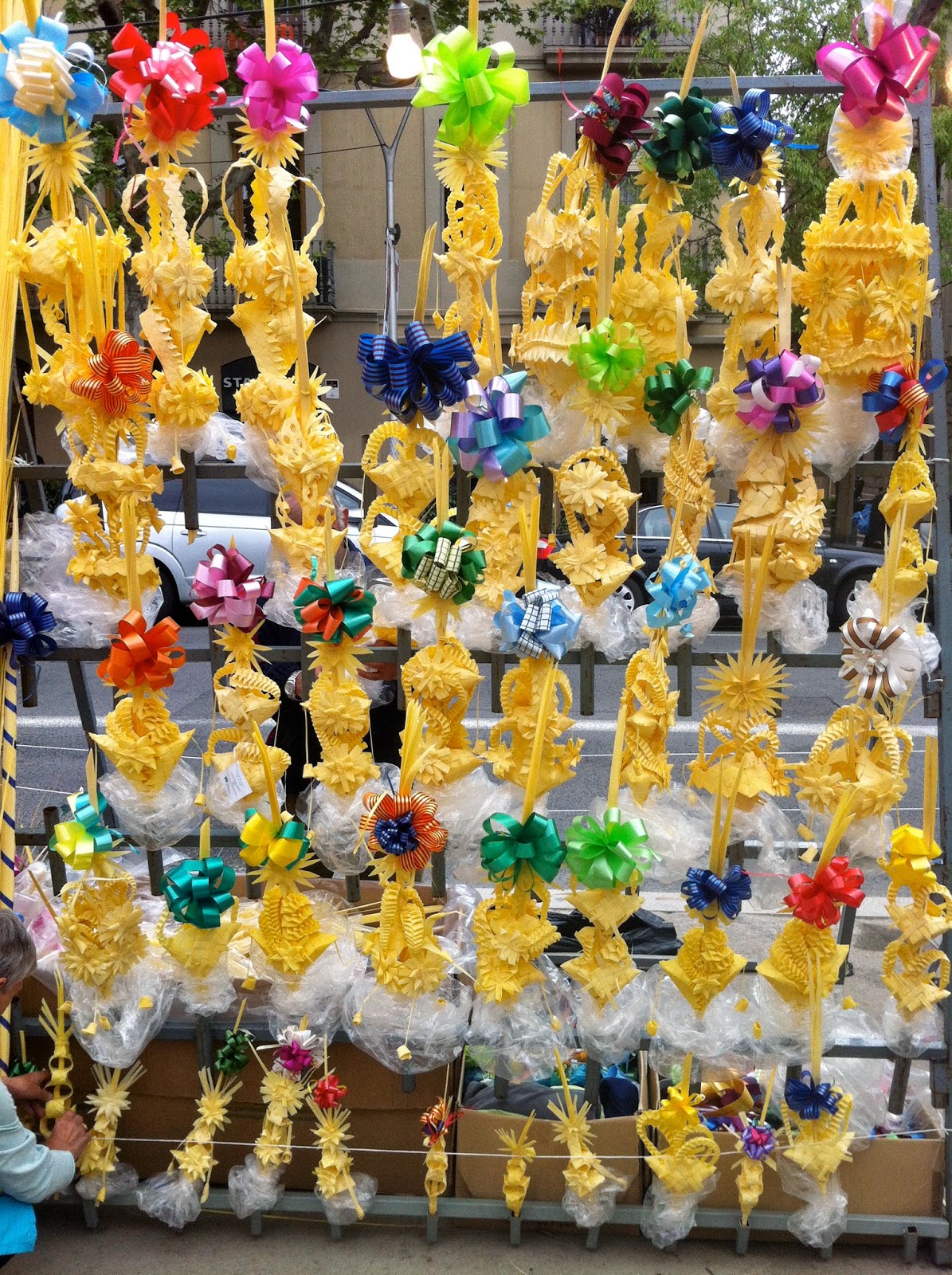
These are Palmónes. They look like sticks wrapped up with ribbon at first sight, but they are actually palm fronds – hence their name, which translates literally into “big palms”. They’re an Easter tradition here in Cataluña, and another one of the curiosities I need to add to my list of things I never saw in Madrid – like Cannelloni for Christmas and the Caganer (which I’ll get to in a minute as I cannot let that one go by without a mention).

It’s Domingo de Ramos (Palm Sunday) today, so the Palmónes are having their day. In Madrid, the (mainly) old ladies will be carrying their more regular palm fronds, minus the elaborate ribbons, home from church to tie onto their balconies.

Here in Cataluña, the Palmónes are the ambit of the kids – specifically the boys. The girls carry smaller, intricately woven versions called Palmas.  Traditionally, it’s the godparents who buy these, but I’m not sure how strictly that is being adhered to as at the Palmónes stalls just around the corner from home I saw what looked like Mums and Dads with their (excited) kids buying them together. I imagine the kids were more excited by the toys and sweets tied to them than any religious or traditional significances.

The intricately woven Palmas, for the girls

These days they use all manner of ribbons on the Palmónes and Palmas – like the Barcelona Football Club ones in the pic at the top. Traditionally though, the ribbons are in the design of the Catalan flag (red and yellow stripes).

A further Palm Sunday tradition is the donning of new clothes. If I’m honest, I can’t say whether this is the same in Madrid as I never came across it there, but here the saying goes that if you don’t wear some new clothes, your hands will fall off(!) Why exactly that is, I’ve not been able to work out…

Now, for that quick note on the Caganer – perhaps the oddest tradition I’ve come across to date. This is a figurine of someone... er... pooing. I’m serious; Cagar in Catalan means to have a poo. It’s not for Easter, but Christmas and you’re meant to pop one in a discrete corner of your nativity scene.

Traditionally they are classic Catalan peasant figures wearing a little red cap, but these days you will find all manner of characters – I’ve seen Bart Simpson, C3P0, Superman, Barack Obama, the list goes on – and all of them are squatting down and having a poo (with pile of poo included!). The true meaning of the Caganer is a bit lost, but many people say it has to do with fertilising the ground to bring prosperity for the year ahead. Whatever the reason, it’s a very curios Christmas tradition…

A traditional Caganer, pile of poo and all. Photo by Mtiedemann 

Wednesday, 9 April 2014

A ninth-century night out of town (Una noche fuera en el siglo nueve)...


The other week, G and I took a short trip out of Barcelona to spend the night in a 9th century castle. Well, the oldest part is 9th century, the rest having been added to, changed, destroyed and rebuilt over the years. Still, pretty awesome to think that we were sharing the same space where people had been living, working, flighting, held prisoner and even tortured (seriously, the anti-room to the current restaurant was actually used as a torture-chamber) over the past thousand years.


Of course to G it’s not such a big deal. He’s from Florence, so grew up surrounded by medieval wonder. But for me, coming from a country in which you’d be lucky to find a building standing that is 200 years old, it’s a thrill - even after all these years living in Europe. Not that G is a spoil-sport, he lets me ramble on about how “amazing” it is to think about all the people who had been standing in this spot or that over this century or that, feigning interest as best as he can. God bless him.


Anyway, it’s called Cardona Castle and is about an hour-drive north-west of Barcelona, in the foothills of the Pyrenees. The setting is pretty spectacular. The castle looks very imposing set up high on a steep hill overlooking the town of Cardona. From one side of the castle there are views up to the snow-capped peaks of the Pyrenees and from the other, to the jagged rock crown of Montserrat. Just behind the town you can see the reason why Cardona was once so important as to deserve a castle like this: a massive salt mountain.


Salt is still being dug out from the Cardona mine, as it has been since even before the Roman’s got there. A tour through the mine is meant to be well worth it, according to TripAdvisor. Unfortunately I didn’t read this until after we got there and we chose to visit on the only day (Monday) that the mine was closed.


There is another reason why Cardona has such an imposing castle. It used to be right on the border with Al-Andalus - Moorish Spain - so it was important for both keeping the Moors back and as a base for incursions into Moorish territory in attempts to claw it back for Christendom.  Also, being so close to France, it was important for keeping out invaders from the north. Legend has it that it was assailed a thousand times and never fell.

The mine and the castle are said to be the main things to do in Cardona, but I think a walk around the medieval town centre is essential too. It won’t take long, it’s small and when we were there at least, there was very little going on. But its narrow, hilly streets, ancient buildings and stone and wooden archways are enchanting.


There is a beautiful, austere 13th century Gothic church there too. It’s greatest treasures were a little hidden from us though as, as so happens in Spanish churches, they are tucked away in dark corners that require a Euro to be inserted into the light switch to allow you to enjoy them – and we walked into the church without a single coin between us.


The castle is these days a Parador hotel. The Paradores is a state-owned network of hotels, a great many of which occupy grand old buildings that form part of Spain’s national heritage. They were started by King Alfonso XIII (Spain's last king before the Second Republic). The idea was that by restoring these buildings and turning them into hotels they could help pay for their own upkeep, both saving them and breathing life into the Spanish countryside via tourism.


If I’m honest, I find the Paradores a little bit stuck in the 70s in terms of their offerings and styling, but the magnificent buildings that many of them are housed in I think makes us for this failing. The Spanish government is currently in the process of selling the Paradores off. This will probably update the offering, I just hope some pretty strict clauses are included for maintaining their important heritage role.