Showing posts with label dictatorship. Show all posts

Monday, 27 April 2015

Shutting-up The People (Callar al pueblo)

Last week, the New York Times published a scathing editorial about a recently passed law here in Spain, officially called “The Law for Citizen’s Safety”, but popularly known as La Ley Mordaza (The Gag Law).

In the editorial, entitled “Spain’s Ominous Gag Law”, which is well-worth reading by the way, the New York Times opined that the law’s purpose appears to be “to help the ruling party maintain its hold on power by discouraging the anti-austerity protests that have snowballed into widespread support for the populist Podemos party”.

I couldn’t agree more whole-heartedly with their assessment, although I’d even go further and suggest that it is an attempt to quell any show of opposition at all to the government’s policies.

As the editorial states, the law introduces massive fines for demonstrating in certain places: 30,000€ for demonstrating in front of government buildings, 600,000€ (yes that's five zeros) for spontaneous demonstrations in front of other places considered “strategic”, 30,000€ for filming or photographing police and soldiers doing stuff(!)

Police blockade at the end of my old street in Madrid. They were blocking the way in case protesters wanted to get close to the HQ of the Partido Popular, the party of the current government

With the new law, I could very well not be able to take a photo like this, or even the one above, for risk of copping a 30,000€ fine

I find this new law both infuriating and terrifying. How is it possible that the government of a western European democracy could even contemplate such a law, let alone actually implement it? To me it reeks of something that belongs in the dark days of 1930s Europe.

The government’s excuse for the law (as it’s name suggests) is security for its citizens and institutions. To me, that sounds like something straight out of the propaganda chapter of “Fascism for Dummies”. It’s also utter rubbish.

For much of the time I have lived in Spain, the country has been gripped by a relentless and brutal economic crisis that has seen general unemployment rise to more than 26% at one point (currently it’s not much better at over 23%).

The degradation and depravation that has accompanied this has been heartbreaking: desahucios (evictions) in their tens of thousands resulting in skyrocketing homelessness; well-dressed pensioners begging in the street; people rummaging through the bins to find something to eat or sell. These are still every-day sights here.

But despite all this, the Spanish have maintained a dignity and control that, as an extrajero, has truly impressed and astounded me. Spaniards don’t just get mad, they get organised. Throughout 2013, there were close to 4500 manifestaciones (demonstrations) on the streets of Madrid alone. I was living right in the centre of that wonderful city that year and I saw plenty of them.

The placard translates to "Organise your rage". 
The Spanish don't just get mad, they get organised

People demonstrated against the crisis, against the government’s responses to it (like cuts to social services, privatisations, new labour laws), against the seemingly never-ending corruption scandals that were bubbling to the surface just about every day, against the foreclosures and evictions.

This 2011 protest was against the crisis in general and the capital that caused it 

This group from a Madrid 2013 protest was in support of the miners from the north of Spain. The big banner reads:
"We're not just indignant, we are "up to the balls", which is a pretty strong was of saying "fed up"

But what was even more striking than such community organisation and action was the lack of violence: in the vast majority (and I'm talking 90-odd percent) of these demonstrations there just wasn’t any. 

That’s what makes the government’s excuse for the Ley Mordaza so unbelievable. Why, if the vast majority of demonstrations in Spain are peaceful, even carnival-like at times, do such draconian measures need to be introduced? They don’t, of course.


A great many demonstrations I saw were attended by whole families...

And all ages.
The placards read: "Use of Common Sense Permitted" and "Enough with the Economic Violence"


Although the reasons for demonstrating were serious, there was often a "carnival" atmosphere.
The top photos is from 2011, the bottom from 2013

I believe with this law the government is attempting to squash this spirit of organisation and action of the people. They don’t want dissent in the streets – especially organised dissent that actually brings results.

The Marea Blanca (the White Tide) were demonstrations by Madrid health workers who managed to stop mass-privatisations in the Madrid region’s health service; the Marea Verde (the Green Tide) were demonstrations by educationalists, students and parents that have caused no end of problems to the government’s education “reforms” and, as the New York Times noted in their editorial, the 15M demonstrations actually spawned a new political party and it is seriously threatening the two-party system that has characterised Spanish politics ever since La Transitión (Spain’s transition from dictatorship to democracy) and hence the government’s grip on power.

The white coats of health workers in a demonstration of the Marea Blanca in 2013 

Huge crowds attended many of the demonstrations, as here in Madrid's Paseo de Prado in 2011

The 15M (May 15th, 2011) protest camped out for weeks in the central Madrid square,  La Puerta del Sol.
This protest would eventually spawn the new political party Podemos.

Spain’s democracy is young - not quite 40 years old – but I always thought it was strong. That this law is being introduced is making me question that.

What I hope is that the many people still around who remember Franco’s dictatorship will smell the reek of authoritarianism in this law and using their skill at organisation and action, put an end to it. 

It is an election year after all.


Some memorable pancartas (placards) I have seen at Madrid demos


No translation necessary


"They (the politicians) don't represent us".
That's the Prime Minister having unspeakable things done to him by a banker


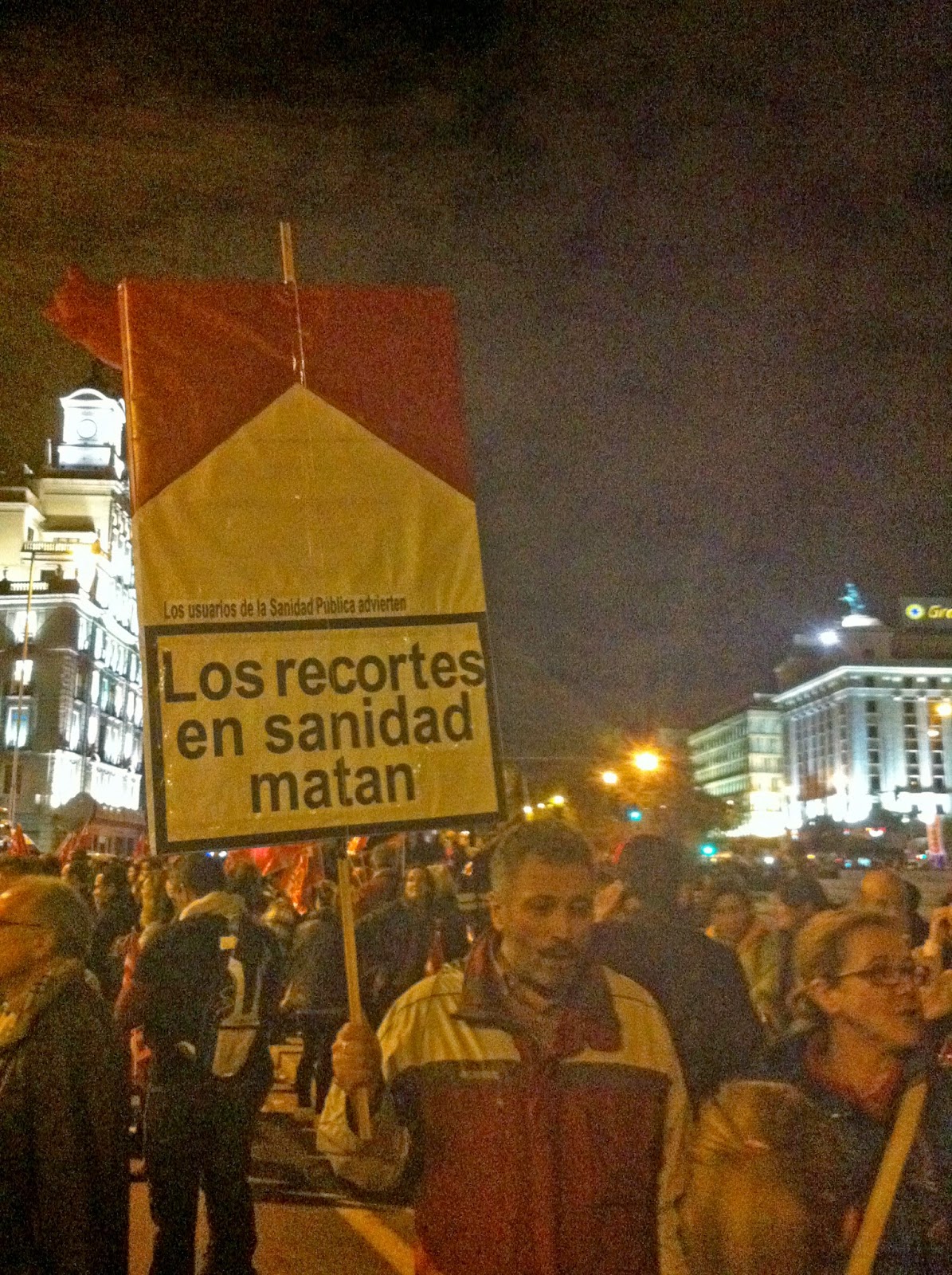
Cigarette pack warning: "Cuts to Health Kill" 


The typical "For Sale" sign that people peg to their balconies when selling their flat. Here is reads:
"For Sale. The Welfare State"

The big red thing is meant to be the famous chorizo sausage. The chorizo has come to represent corruption and waste.
The banner underneath reads "Looking for honourable and committed politicians. Are there any around?"

Saturday, 29 March 2014

Farewell to “the leader who changed the history of Spain" (Adiós al “líder que cambió la historia de España” )…


Spain has been in mourning this week.  Adolfo Suárez González, the first democratically elected Presidente del Gobierno (Prime Minister) after Franco’s dictatorship, died on Sunday (March 23).

Suárez was Prime Minister from 1977 until 1981, as Spain transitioned from dictatorship to democracy – what the Spanish call simply "La Transición" (The Transition).

Now, and this is probably something you'll hear from time-to-time in this blog, it completely blows me away that the country in which I am living has been a democracy for only 37 years.

I’m sure that’s because I come from a country that has only ever known democracy (at least for its non-indigenous citizens), which probably makes me a little naive. And my Eastern European friends will remind me that their democracies are even younger. But that still doesn’t dull my fascination and (even) awe.

There are some aspects of Spain that I wonder might be signs that the democracy is still young(ish). Corruption, that so flourished during the dictatorship, is still rife in the political and business worlds (although the country been getting a better handle over it just in the years that I’ve lived here); the virtually undisguised disdain which many of the powerful still hold towards ordinary people; the influence that the Church blatantly still tries to wield and the strikingly authoritarian views that often appear in the conservative media (some of the worst offenders being TV and radio stations owned by these same Bishops), are some examples.

But there are positives too. One, for me, is the fervour with which the Spanish protect their rights and freedoms. Perhaps this is because there are so many people still alive who remember living without them. I think that in some slightly older democracies, like my own, we take these rights so for granted that we can sleepwalk into them being eroded.

Spaniards on the other hand, are very quick to recognise a threat and organise themselves to fight it – often into massive movements. I’ve mentioned before the astounding number of manifestaciónes (demonstrations) that have been held in Spain since the economic crisis hit - 25,461 just last year!  And whilst it is true that most of these have their roots in the economy, many people think the measures being taken to combat the crisis are also leading to an erosion of their rights and freedoms.

There have been the mareas ciudadanes (citizens' tides) of varying colours (white for health, green for education, violet for women’s rights), movements for better democracy have camped out for months in Madrid’s central Puerta de Sol square and people have marched from all points of the country to converge into macro-manifestaciónes in the capital.

The sheer number, participation, energy, variety and (in the vast majority of cases) peaceful and festive natures of these demonstrations have been truly awe-inspiring to me, as an extranjero. Things did get very ugly just the other day though: 67 police and 34 protesters were injured when violence broke out at the end of a demonstration, in scenes like nothing I had ever seen in all the demonstrations I witnessed whilst living in Madrid (and I saw a lot of them). I hope it's not a sign of things to come…

Regardless of whether I’m right to (perhaps cheekily, or worse) suggest that these are signs of Spain’s democracy being “young”, there is no denying it is strong and modern – something that most Spaniards are very proud of.

And that takes us back to Adolfo Suárez. Just about everyone I’ve heard talk of him this week, including ordinary Spaniards, interviewed as they waited in a two and-a-half km queue for their turn to file past his coffin, agree that the road to Spain’s democracy might have been very different without Suarez and his ability to both find consensus and persuade during the very tricky time that was La Transición.

And it is for this, much more than simply being the first democratically elected PM, that Suárez was farewelled with such honours. The title of this post I’ve taken from a newspaper headline and sums up perfectly how Spain sees Adolfo Suarez: he was the man who changed the history of the country. And just 37 years ago(!)

Saturday, 1 March 2014

“Rosaries out of our ovaries!” (“¡Fuera los rosarios de nuestros ovarios!”)


As I write this post, a fierce social argument is raging in Spain. Well, the truth is, after six years of brutal economic crisis and all that comes with it: unemployment (26%, rising to 57% for the under 25's), massive cuts to health, education, social services and pensions, increasing homelessness, etc, it’s not nearly the only one. But I wonder if this one might eclipse all others in it's potential for divisiveness. And it has nothing to do with the economy. 

Spain's Cabinet - el Consejo de Ministros - has recently approved a new abortion Bill. If passed into law, it will not only remove the free choice that women here have had since 2010 to abort in the first 14 weeks of pregnancy, but also make it harder for them to have an abortion than it was back in 1985, when Spain's first abortion reform was introduced following the dictatorship.

The new Bill recriminalises abortion in all circumstances except two: 1) in the case of rape and 2) where it can be proven (by two doctors or psychologists) the pregnancy will cause serious physical or psychological harm to the mother. 

In the 1985 reform there was also a third exception: malformation of the foetus. This is not in the new Bill, which is one of the reasons why there is so much opposition to it. 

Other arguments against it are that it will push woman back into the dark-old-days of backyard abortions and the risks that go along with that; an increase in inequality amongst Spanish woman as those who can afford it will simply go to Portugal, France or the UK to abort (which they used to do en-masse); or the conversion of doctors and psychologists into the moral guardians of Spanish women.

All these are important and valid reasons for opposition to the Bill, but in my opinion, they are not the core reason why this Bill has the potential to be so divisive.

The Spanish are very proud of the way their country has modernised (industrially, politically and socially) in the 30-odd years since the end of Franco’s dictatorship. These gains many Spaniards feel where very hard fought and so the idea of going backwards is abhorrent to them.

Furthermore, we’re talking about abortion, so it’s intrinsically linked women and their place in society. Back in the Franco’s day, a woman’s place was in the home, “cómo Diós manda” ("as God commands"). Women could not even open a bank account or apply for a passport without the permission of their husband (or if she didn’t have one of those, her oldest male relative). 

So you can imagine how many women here now feel about being told they are going to lose a right they currently hold to make decisions about their own bodies. 

Also, as the title to this post suggests (it’s one of the catch-phrases being used in demonstrations against the Bill), there is the Church. Although the connection of the Church to power in Spain goes back much further than the dictatorship (just think about the Inquisition), in Franco’s Spain, the Church was both protected by the State and its great defender. Franco named his form of government “National Catholicism”, thus cementing the Church’s undeniable connection with the State.

Spain’s democratic constitution of 1982 separated Church and State, so many Spaniards feel that this Bill is a concession by the government to the Church, which threatens that separation.

So why do I wonder if this fear - and anger -  of going backwards (in rights and as a society) has the potential to trump the divisiveness resulting from the economic measures the government has put in place to combat the “Great Recession”?

Don’t get me wrong, there is great opposition to the government’s spending cuts (in 2013 alone there were 25,461 recorded demonstrations in Spain, mostly to do with these cuts) but it seems to me that a lot of people are still prepared to give the government the benefit of the doubt that they are essential to get the economy back on track.

But the abortion Bill is not about the economy. For a great many Spaniards it is about cutting a personal liberty that will take their society more than thirty years into the past. And in that, they’re not prepared to give the government the benefit of the doubt.


Some demonstrators’ slogans, L-R: “Vagina armed, vagina respected”. Actually the word “coño” is more akin to our C-word. but it is not nearly as offensive in Spanish. In fact, the Speaker of Parliament here has been known to use it from time-to-time when trying to cool down the House during the more fiery debates. “Illegal abortion = the dealth of justice & equality”. “Take your rosaries out of our ovaries”.