Showing posts with label madrid. Show all posts

Friday, 24 July 2015

Hot! (¡Que calor!)...

It's hot. Really hot. Unusually hot. Not that Spain isn’t used to the heat, it’s just that it's started really early this year. Since the end of June, it's been one ola de calor (heatwave) after the other. And there was also a heatwave back in May that saw 40°C temperatures in many parts of the country. This really shouldn’t really be happening until August.

In Madrid, the temperatures have got the hosteleros (bar owners) worried. Their terrazas (outside areas) have been deserted during the day, meaning they’re losing a tonne of money – although I suspect they’d be doing a roaring trade once the sun goes down. 

More worrying is the damage to agriculture. The Galician potato crop has been decimated, as has the corn. The sea temperature in the Mediterranean has already hit 30°C in some places along the coast, which has sent the Lubina (sea-bass - a favourite here in Spain) scurrying for colder waters.

Back in Galicia, in some parts they haven’t even been able to drink tap water as the high temperatures have led to a increase in a certain sort of toxin. 

It’s the effects of cambio climático (climate change), the government has admitted.

I'm writing this post sitting in the shaded terraza of a bar with a cerveza bien fria (nice cold beer). It's a favourite way to beat the heat for me.

Writing this post with a cerveza bien fria. That's some interesting balcony furnishings in front of me

Here in BCN we've also got the beach for that - although if you're a local you'll most likely head slightly out of town for a dip. Barcelona's city beaches (like the Barceloneta) are great for a walk, jog or cycle along their wonderful, palm-lined broad walks, but swimming is mainly for the tourists.

Las Platja de la Barceloneta (Barceloneta Beach)

A good hint that there might be a lot of tourists here: the information signs are in English.
Oh and yes, you can still smoke on the beaches here

You will find some locals at Bogadell or Mar Bella beaches, but most will head out of town if they can - just a little north to places like Ocata or south to Gavá or Sitges (all of which are really easy to reach by the local trains).


La Platja de Gavá (Gavá Beach). If you're looking for a wide, kms long, sandy beach, this is a great choice

We popped down to a place not far from Gavá called Garraf the other day – it’s a gorgeous little beach lined with little wooden holiday shacks. There’s a great beach-side restaurant there too called El Chiringuito de Garraf that does a sensational paella. 

Just a bit on from Gavá is Garraf. Much smaller but very cute. Check out those little wooden holiday shacks lining the beach.

My favourite beach though is Balmins Beach in Sitges. Balmins is just a little north of Sitges’ main beaches and much more natural and relaxed - although that doesn’t mean there’s not a chiringuito (beach-side bar) right there on the sand for that cerveza bien fria when you need it.

Balmins at sunset. That's Sitges' stunning old-quarter in the background. 

Balmins is officially a nudist beach, but in reality it’s very mixed and a favourite with all sorts – young, old, gay, straight - swimsuited or not.

In Madrid, reaching the beach is somewhat more complicated, but not impossible as in the AVE (the high speed train), it's only 90 minutes to Valencia. Still, that takes a bit of planning (and it’s not exactly a cheap day at the beach), so a lot of people head to the municipal pools or the pantano (dam) for a swim.


I made the trip to the Pantano de San Juan just once. It's a beautiful spot to the south-west of Madrid - a huge expanse of water surrounded by lovely bushland. But - and it's a big but - it's dirty. Not enough bins and too much of a propensity for the punters to dump their picnic and BBQ leftovers in the bushland ruined it for me.

What I used to do most when it was hot in Madrid was head to El Retiro, Madrid’s fantastic city park. I’d lie in the shade of a gum tree (surprisingly the park is full of them) or to really knock two or three degrees off the air temperature, take a wonder through the park’s forested grottos. You’d be amazed at how much cooler it is there.

There's a surprising number of gum trees in Retiro, especially down on the lawns at the Atocha end.

Retiro has stunning woodlands right in the centre of town. 


Despite all this talk about keeping cool, I’d much rather be hot than cold. I’ve always been that way, although 8 years in London did confirm it.

Still, being so hot from so early in the year is a bit of a concern. Even more of a worry is that while one government department here is acknowledging that this heat is a result of global warming, another of that same government is cutting subsidies for renewables and even worse, is planning to introduce new taxes to penalise those who have bothered to install rooftop solar with storage capacity!

It’s enough to make you wonder if the government is suffering a bout of heatstroke from this ola de calor

Tuesday, 23 June 2015

Adiós Botella...


I love this video - and not just because its protagonists are three scary-fabulous drag queens working it in some of the most emblematic locations of my beloved Madrid. I love it because it represents to me a lot of what I admire and, as an extanjero, find so interesting about the Spanish.

In order to explain what I mean by that, I need to give you a bit of background.

Kiki Lorace and her lovely ladies of the video are welcoming Manuela Carmena, a seventy-one year-old ex-judge to the alcaldía (Mayorship) of Madrid and politely saying “bugger off” to Ana Botella (drag on left), the previous Mayor who was not actually contesting this time, and her party-mate Esperenza Aguirre (drag on right), one of the most powerful and divisive forces in Spanish politics, who was hoping to keep the city in the hands of the conservative People’s Party (PP).

The fact that Manuela is now Mayor of Madrid is a pretty big deal.

On a local level, because it brings an end to 24 years of PP rule in the Spanish capital, something I imagine most drag queens (and anyone else of a progressive tilt) is pretty happy about.

On a national level it represents something extraordinary that has happened in Spain recently: the apparent end of the two-party dominated system that has characterised Spanish politics since the transition to democracy in 1978.

Manuela is a member of a party called Ahora Madrid (Now Madrid), which in reality isn’t exactly a party, but rather a collective of left-wing parties and community organisations. Very importantly, Ahora Madrid is backed by Podemos, a new political party that has emerged with a bang of Spain’s political scene.

Here’s a pretty in depth story from the Guardian about Podemos, so I won’t go too much into it, apart from to say that the party evolved from a grass-roots movement that was, amongst other things, fed up with what they saw as the inaction of the traditional political parties to alleviate the misery that the financial crisis has wrought on the people of this country.

Spain’s second city, Barcelona, is celebrating a new alcaldesa (Mayor) too - Ada Colau. Her group, Barcelona en Comú is similar to that of Manuela and also has connections with Podemos. Colau entered public life as the controversial leader of a community group dedicated to stopping the evictions of people unable to pay their rent or mortgage.


Campaign poster for Ada Colau's successful run for Mayor of Barcelona

And in Spain’s other major cities, Podemos and other new political parties and coalitions have taken the top jobs or facilitated the changing of the guard.

The truth is, nobody really knows whether these new parties and coalitions will be stable enough to actually work, but a great many voters are obviously prepared to take the risk in the search to for something they feel is better than the traditional politics.

Now back to the video. It has always been in the best traditions of drag to be political. “Men dressing up in women’s clothing and mouthing the words to other people’s songs,” as Guy Pierce’s character says in The Adventures of Priscilla, Queen of the Desert is not just about men wanting to dress up in frocks (although I’m sure there is a lot of that). It’s also about making a statement, challenging the accepted gender roles in society and everything that that represents.

But having said, I’m finding it hard to remember any recent time when a bunch of drag queens got so excited about a political party that they bothered to make a music video celebrating it – at least one with such good production values.

Kiki & Co's excitement wasn’t an isolated incident either. Graphic designers and artists developed pro-Manuela imagery and uploaded it to social networks, taxi drivers donated the sides of their cabs for campaign posters, all manner of people organised themselves to lend their time and skills in support of Manuela.

An animated gif from an artist involved in the Madrid with Manuela collective
- a sort of unofficial campaign group for Manuela's bid to be Mayor of Madrid

It is this get-up-and-go, this ability to self-organise in the most creative, interesting and effective ways - so often with the good humour shown in the video - that I find so admirable about the Spanish. In fact, I've written about it before.

And whether or not you agree that this new politics is the way forward for Spain, or anywhere for that matter, I don’t think there is any denying that the courage and optimism it conveys, let alone its recent successes, is very exciting.

Monday, 27 April 2015

Shutting-up The People (Callar al pueblo)

Last week, the New York Times published a scathing editorial about a recently passed law here in Spain, officially called “The Law for Citizen’s Safety”, but popularly known as La Ley Mordaza (The Gag Law).

In the editorial, entitled “Spain’s Ominous Gag Law”, which is well-worth reading by the way, the New York Times opined that the law’s purpose appears to be “to help the ruling party maintain its hold on power by discouraging the anti-austerity protests that have snowballed into widespread support for the populist Podemos party”.

I couldn’t agree more whole-heartedly with their assessment, although I’d even go further and suggest that it is an attempt to quell any show of opposition at all to the government’s policies.

As the editorial states, the law introduces massive fines for demonstrating in certain places: 30,000€ for demonstrating in front of government buildings, 600,000€ (yes that's five zeros) for spontaneous demonstrations in front of other places considered “strategic”, 30,000€ for filming or photographing police and soldiers doing stuff(!)

Police blockade at the end of my old street in Madrid. They were blocking the way in case protesters wanted to get close to the HQ of the Partido Popular, the party of the current government

With the new law, I could very well not be able to take a photo like this, or even the one above, for risk of copping a 30,000€ fine

I find this new law both infuriating and terrifying. How is it possible that the government of a western European democracy could even contemplate such a law, let alone actually implement it? To me it reeks of something that belongs in the dark days of 1930s Europe.

The government’s excuse for the law (as it’s name suggests) is security for its citizens and institutions. To me, that sounds like something straight out of the propaganda chapter of “Fascism for Dummies”. It’s also utter rubbish.

For much of the time I have lived in Spain, the country has been gripped by a relentless and brutal economic crisis that has seen general unemployment rise to more than 26% at one point (currently it’s not much better at over 23%).

The degradation and depravation that has accompanied this has been heartbreaking: desahucios (evictions) in their tens of thousands resulting in skyrocketing homelessness; well-dressed pensioners begging in the street; people rummaging through the bins to find something to eat or sell. These are still every-day sights here.

But despite all this, the Spanish have maintained a dignity and control that, as an extrajero, has truly impressed and astounded me. Spaniards don’t just get mad, they get organised. Throughout 2013, there were close to 4500 manifestaciones (demonstrations) on the streets of Madrid alone. I was living right in the centre of that wonderful city that year and I saw plenty of them.

The placard translates to "Organise your rage". 
The Spanish don't just get mad, they get organised

People demonstrated against the crisis, against the government’s responses to it (like cuts to social services, privatisations, new labour laws), against the seemingly never-ending corruption scandals that were bubbling to the surface just about every day, against the foreclosures and evictions.

This 2011 protest was against the crisis in general and the capital that caused it 

This group from a Madrid 2013 protest was in support of the miners from the north of Spain. The big banner reads:
"We're not just indignant, we are "up to the balls", which is a pretty strong was of saying "fed up"

But what was even more striking than such community organisation and action was the lack of violence: in the vast majority (and I'm talking 90-odd percent) of these demonstrations there just wasn’t any. 

That’s what makes the government’s excuse for the Ley Mordaza so unbelievable. Why, if the vast majority of demonstrations in Spain are peaceful, even carnival-like at times, do such draconian measures need to be introduced? They don’t, of course.


A great many demonstrations I saw were attended by whole families...

And all ages.
The placards read: "Use of Common Sense Permitted" and "Enough with the Economic Violence"


Although the reasons for demonstrating were serious, there was often a "carnival" atmosphere.
The top photos is from 2011, the bottom from 2013

I believe with this law the government is attempting to squash this spirit of organisation and action of the people. They don’t want dissent in the streets – especially organised dissent that actually brings results.

The Marea Blanca (the White Tide) were demonstrations by Madrid health workers who managed to stop mass-privatisations in the Madrid region’s health service; the Marea Verde (the Green Tide) were demonstrations by educationalists, students and parents that have caused no end of problems to the government’s education “reforms” and, as the New York Times noted in their editorial, the 15M demonstrations actually spawned a new political party and it is seriously threatening the two-party system that has characterised Spanish politics ever since La Transitión (Spain’s transition from dictatorship to democracy) and hence the government’s grip on power.

The white coats of health workers in a demonstration of the Marea Blanca in 2013 

Huge crowds attended many of the demonstrations, as here in Madrid's Paseo de Prado in 2011

The 15M (May 15th, 2011) protest camped out for weeks in the central Madrid square,  La Puerta del Sol.
This protest would eventually spawn the new political party Podemos.

Spain’s democracy is young - not quite 40 years old – but I always thought it was strong. That this law is being introduced is making me question that.

What I hope is that the many people still around who remember Franco’s dictatorship will smell the reek of authoritarianism in this law and using their skill at organisation and action, put an end to it. 

It is an election year after all.


Some memorable pancartas (placards) I have seen at Madrid demos


No translation necessary


"They (the politicians) don't represent us".
That's the Prime Minister having unspeakable things done to him by a banker


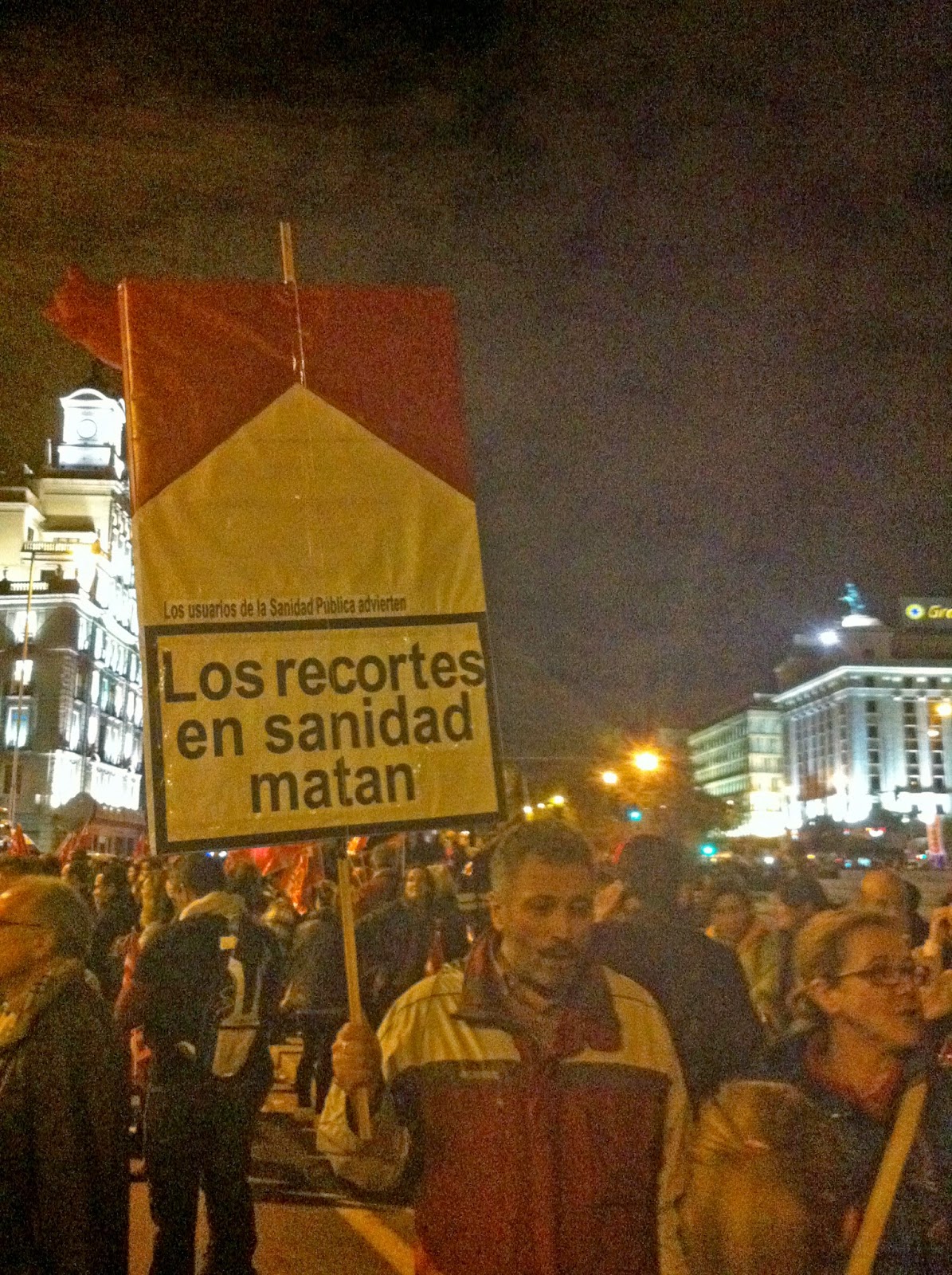
Cigarette pack warning: "Cuts to Health Kill" 


The typical "For Sale" sign that people peg to their balconies when selling their flat. Here is reads:
"For Sale. The Welfare State"

The big red thing is meant to be the famous chorizo sausage. The chorizo has come to represent corruption and waste.
The banner underneath reads "Looking for honourable and committed politicians. Are there any around?"

Wednesday, 15 April 2015

Spring… at last! (Primavera…¡por fin!)…

Just south of Barcelona’s El Prat airport, there is a little sea-side town called Gavá. It’s home to an impressively wide, kilometres-long beach, a fair few footballers’ villas and one of my favourite chiringuitos (beach-side restaurants), perhaps somewhat wishfully-named Kuwai.

We were there not long ago, tucking into a scrumptious lunch of grilled cuttlefish, ham croquetas and patatas bravas, while simultaneously scanning the sky to for a glimpse of the A380 due to take off any moment and carrying Mum back to Australia, when suddenly a familiar though long-absent excitement struck me: I could feel spring in the air.


What is it about the arrival of spring in the northern hemisphere that gets the juices flowing so? I don’t remember it being quite so captivating back in Australia – although having said that, I do remember a lot of relationship break-ups around this time of year, as “winter warmers” were shed for new springtime dalliances. I guess that’s biology.

Up here in colder climes, I imagine it also has a lot to do with the leaving behind of those long, dark, “dead” months. I remember in London how the first sighting of sprouting daffodils made my heart leap and the first sunny days of Spring saw the pubs empty as the punters crowded onto the footpath outside, wearing t-shirts (and sometimes even shorts) to enjoy their pints basking in the sunshine (even if it was only 12 degrees).

Of course here in Barcelona it’s not that extreme. Even in Madrid, where winter may not be as long as in London but is still pretty brutal, the only ones in t-shirts and shorts at this time of year are visiting guiris (foreigners) – and the more… er… excitable queens.

But still, the thrill is palatable.

I’m writing this post sitting in the terraza (terrace) of a local bar, not really caring that the sun is somewhat scalding my winter-bleached, follicular-challenged head.


In the park just across the road, pink and purple blossoms are filling the spaces where soon new leaves will be and on the faces of the people walking by, smiles have replaced the frowns of just a few weeks ago.


This excitement is a wonderful thing; a true recognition of and enjoyment in the change of the seasons - in nature I suppose. I’ll miss it when I finally head “home”.

Thursday, 16 October 2014

A year in Barna already (Un año ya en Barna)


A year ago today we drove into a sunny, autumnal Barcelona, dog-in-tow, to start the next chapter of our lives. We were filled with mixed feelings. On the one hand, we were excited. This was the next big step for G in his career; we knew we were moving to a beautiful city; we were going to be living by the beach again; we already had some friends here waiting for us.

But on the other hand, just a day before we had said a sad goodbye to our friends and our life in Madrid. Seven years is more than enough time to develop meaningful relationships, both with people and places.

So how has this year been? Well if I’m honest, it’s been a little tough. Of course it’s never the same living somewhere as experiencing it as a tourist. But we knew that - it’s not the first (or the second) city we’ve moved to.

And it’s not like haven’t established a life here. We’ve embraced, with some relish, the substitution of Madrid’s (in)famous vida nocturna (night-life) for lovely Sunday lunches with friends on the beachfront and cocktails in stylish terrazas (roof-top bars).  I find myself savouring more than ever our walks along the tree-lined, architecturally rich grid-streets of the Eixample or through the narrow, crooked alleys and slanting buildings of the Gothic and Born districts. As I’ve mentioned previously, I’m left feeling privileged by my daily dog-walking ritual past the Sagrada Familia church. And G’s professional success over this last year fills me with pride and him with a sense of accomplishment.


No, the “problem” is not a lack of a life here, it’s that having so embraced our Spanish life back in Madrid, the move to Barcelona made us feel, quite unexpectedly, that we weren’t living in Spain any more!


Pic: assamblea.cat

Now that might sound a little crazy, but I’ve come to believe that what the Catalanistas like to say rings somewhat true: Cataluña is not Spain. Of course it is geo-politically, but culturally and socially it is quite different. And I don’t think that we were prepared for that.

So this is the reto (challenge) for our next year here: to really say goodbye to Madrid. To stop comparing our old home with our new one and just enjoy Barcelona for what it is: a shimmering jewel on the shores of the Mediterranean with stunning architecture, sensational weather and way of life and a culture that is its very own.

Sunday, 18 May 2014

The season kicks-off (Arranca la temporada)...


Well it seems that the season has kicked-off here in Barcelona and even though it’s early days, it is looking like our first verano (summer) here is going to be a good one.

Up 'till now, I wasn't so sure. Now I know it could almost be considered a sacrilege to say so, but I’ve got to admit to finding Barcelona a little dull our first months here. Friends reminded me that it was “winter after all”, but I suppose I had become accustomed to Madrid, whose streets are teeming (with locals) even during the cold months. I was starting to get a little worried.

It seems I needn’t have. With arrival of the first weekends of sun and warmth, Barcelona has started to fill with the air of excitement and expectation that comes with a summer by the sea.

It’s been so long since I have lived by the beach – 15 years for goodness sake – that I’d forgotten what a costal city was like. Really, it’s very similar to Sydney. Despite how good the winter weather actually is, compared to say London or even Madrid, winter is a time of hibernation for the locals. Then, as the days get longer and the sun starts to not only shine, but actually radiate heat, the winter dens are abandoned and all hell breaks loose.

Well, OK, I’m not as young as I used to be, so “all hell” is probably not going to “break loose” for me, but certainly the sangria, mojitos and caipirinhas have started to flow and helped to wash down some plentiful servings of paella and seafood at some of the fabulous chiringuitos (beachside restaurants and bars) here in Barcelona.


We’ve found ourselves at the Barceloneta a lot these last few weeks. This is downtown Barcelona’s beachside barrio (neighbourhood) that also gives its name to the beach there - although I’m not sure if many locals actually go there to swim as there are nicer beaches just a little further up and down the coast. 

The beach at the Barcelona is actually what’s left of a series of islands once off the coast, and the barrio built on land reclaimed from the sea that used to separate the two. On one side there is the old port and on the other the sea, so you actually feel like you’re surrounded by water.

Both the barrio and the beachfront are packed with bars and restaurants that fill up with tourists and locals alike. Some of the restaurants, especially on the main drag, look a little touristy to me (photo menu boards and over-eager waiters standing outside trying to hustle you in), so I’ve steered clear of them.  But we’ve found some good and fun places, and already whiled away some lovely long afternoons with friends there.

And it’s only May. Bring it on…


Saturday, 22 March 2014

Why I got hooked on Madrid (Por qué Madrid me enganchó)…


A while back I mentioned that my initial plan was to move to Barcelona “until I discovered Madrid”. Well, here is why that is.

I was very lucky on my first trip to Madrid – it coincided with “La Paloma” (The Dove).  La Paloma is a magical time in Madrid, when the streets of the central barrio (neighbourhood) of La Latina cram full of families, young people, old people, Chulapas and Chulapos (see below), bewildered but delighted tourists – everyone. Its roots are religious, La Paloma is a sort of patron saint of the city, but as so often happens in Madrid and Spain, the religious and the social swirl together into a whirlwind of colour, dancing, food, drink and general fun.

Chulapas & Chulapos

There is a procession: the portrait of La Virgen (the Madonna) of La Paloma is carried on high from the church where she hangs during the rest of the year, through the streets of the barrio, accompanied by the woodwind and percussion bands that mark most religious processions and led by Madrid’s bomberos (firemen) of whom she is the (unofficial) patron.  But this procession is just a couple of hours bookended by a couple of days of other festivities.

La Paloma's portrait being carried through La Latina

La Paloma represents so much of what Madrid is, and why it enchanted (and still enchants) me. Everything is full to over-flowing: the narrow streets, the typically tiny bars, the tables and chairs crammed into the squares. The noise is thunderous: patrons yelling orders at the barmen, punters in bars or in the street singing along at the top of their voices to traditional songs or trashy Spanish pop, DJs blaring tunes out into the street from the younger (or gayer) watering holes.

La Latina's streets crammed with La Paloma revellers

Madrileños are most comfortable when outdoors and in throngs. Even the solemn and haunting processions of Semana Santa (Holy Week) are massive, although strangely - eerily - quiet, affairs. Madrileños attend these processions in their thousands, year after year, to catch a glimpse of their favourite Virgen or Jesús (Jesus) pass by them, held high on staggeringly elaborate alters.

One of Madrid's many Virgens in procession during Samana Santa

The rather creepy-looking Nazarenos during Semana Santa

Being smack-bang in the middle of the country, there’s no seaside to congregate along, like in Barcelona, so in Madrid it is all about the street (or local square). And especially at night.

There is a wonderful scene at the end of Almodóvar’s film “Carne Trémula” (“Live Flesh”), where Victor, stuck in traffic and trying to get his girlfriend to hospital to dar a luz (give birth – literally “give light to”), attempts to distract his son-to-be from arriving in the taxi, by telling him about the Madrid of his birth, also on the way to hospital, at night, back in the days of the dictatorship:

“Look at the footpath full of people. When I was born, there wasn’t a soul in the street. The people were shut up in their houses, scared shitless. Fortunately for you my son, in Spain, we stopped being scared a long time ago.”

Maybe this has something to do with Madrid’s liveliness; maybe the Madrileños are making up for the 40 years they lost whilst being forced to deny their nature. Whatever the reason, these teeming nighttime streets fascinated and thrilled me from the start.  

Different urban “tribes” do favour particular barrios over others, but the segregation never feels as complete as in some other places. Perhaps it’s because the barrios are pretty close to each other, so people tend to spill from one into the other. Also, all are still home to their vecinos de toda la vida (residents who have lived there all their lives) who share their streets, squares and even bars with their new(ish) neighbours.

But if I had to generalise, the barrio demographics go like this:  Chueca for your gays, Malasaña your Hipsters (or as we call them in Spain, “Modernos”), around Sol and in Las Letras your tourists and Lavapies, an amazing mix of many: your grungier, arty/designer-types, Muslim immigrants (it was here, in the locotorios  (internet and long distance phone-call shops), cafes and curry houses that the 11-M bombings were planned), Chinese fashion wholesalers and your young gays, who have begun moving here as Chueca has got too expensive. Some friends of mine visiting from Australia a while back got themselves “lost” in Lavapies, emerging some time later in possession of some of Morocco’s rather prized export…

Chueca during Orgullo (Gay Pride)

Vecinas de toda la vida in Malasaña

And then back to La Latina. This is one of Madrid’s oldest areas - the buildings lining the narrow Cava Baja street are built on the foundations of Madrid’s ancient Moorish city wall. It rocks during Madrid’s most important festivals (like La Paloma) but the rest of the time, it’s the place to be on a Sunday afternoon, when it’s myriad tapas bars fill to overflowing with all manner of Madrileños, looking to soak up the last hours of the weekend.

Here we are again at the Madrileños love of sharing experiences. There's a timetable to living in Madrid: Saturday afternoon is un paseo (a walk) through Sol and the central shopping district, Saturday night Chueca, Malasaña or Lavapies, Sunday morning “El Rastro”, a massive flea market that has been going on forever, and Sunday afternoon, the tapas bars of La Latina. These traditions feel rather small-town-in-the-big-city (more than 4 million people live in Madrid). And it's nice. You always know where you can find the crowds, if you're in the mood.

There’s so much more to tell about life in Madrid, but it’ll have to wait for another time. For now, I hope I’ve given you a little taste of why Madrid me enganchó (hooked me) and has never has let go, even though I’ve left there… for now. 

Friday, 14 March 2014

The Madrid bombings, ten years on (Diez años despues del 11-M)...


This week, on the 11th of March, we marked the 10th anniversary of Spain’s worst-ever terrorist attack. On the eve of that anniversary, something happened that hasn’t been seen in this country since 2007: all the main Victims of Terrorism groups stood together in an act of remembrance of that terrible day.

It seems unbelievable that this could be the case; that such an atrocity didn’t unite the country as it did the United States after September 11. Of course, in the beginning it did, but it didn’t take long for politics to pollute things. 

On that crisp morning of March 11, 2004, fundamentalist Islamic terrorists left 13 backpacks chock-full of explosives on four of Madrid’s suburban trains (Cercanías). Using the clocks in mobile phones, the bombs were timed to go off within minutes of each other during the hora punta (rush hour). The result was 191 passengers killed and more than 1800 injured.

I wasn’t living in Madrid at the time, but I can understand the disbelief, pain and fear the Madrileños would have suffered that day. I was a London resident when, just a little over a year later, its transport system was attacked and its people killed.

The day after the attack, more than two million Madrileños braved the pouring rain to take to the streets in both homage to the victims and to furiously demand an end to terrorism in their country. Similar marches were held all over the country. The solidarity and dignity visible in the images of Madrid’s main thoroughfares filled to overflowing in a sea of umbrellas and banners are both impressive and very moving.

But the attacks took place just three days out from a general election. Up until 11-M, as the Spanish call both this day and the attacks, the incumbent government of the conservative Partido Popular (People’s Party - PP) was ahead of the opposition Socialist Party in almost all the polls.

The government’s immediate conclusion, and that of just about everyone else, put the blame squarely on the shoulders of the Basque terrorist group ETA. It made sense; ETA terror had cost the lives of more than 800 people in Spain during their 30-odd years (at the time) of violent activity.

Very quickly however, literally in a matter of hours, doubts began to arise in the minds of police, security forces, terrorism experts and journalists - militant Islam started to look like a possible culprit. But the government steadfastly refused to accept that ETA was not the perpetrator and in press conference-after-press conference, press release-after-press release, it insisted ETA was to blame.

The opposition seized on this refusal in the face of the mounting evidence. Soon people were demonstrating in the streets demanding to know “¿Quien ha sido?” (“Who was it?”). And of course, the connection was made between the government’s (highly unpopular) robust support for the Iraq War and the attacks.

Whether it was the Iraq connection or the fact that the government’s belligerent denial of what was seemingly becoming undeniable led people to feel it was trying to hoodwink them, come election-day the Aznar government was swept from power.

The political lines had been drawn right through the middle of the atrocity. The Right accused the Left of using Iraq to blame the government for the terrorist attacks in order to win the election. The Left accused the Right of refusing to accept fundamentalist Islamic terrorism as the culprit because ETA was more politically advantageous. Even worse would come later.

Just over two weeks after the attacks, seven of the terrorists (all Islamists) blew themselves up in a flat in the south of Madrid when cornered by the police and security forces. Three years later, Spain's Audencia Nacional (National High Court) determined the attacks to be the work of fundamentalist Islamists and convicted 21 people. It found no evidence of the involvement of ETA or of other conspiracies.

But Aznar and some other members of the PP have never stopped insisting on ETA’s authorship of the attacks,that they had worked together with the Islamists. Another far more sinister conspiracy theory that emerged is that the attacks were in fact a Socialists coup aimed at winning the general election and that police, security forces, intelligence agencies, judges, prosecutors, witnesses and others were involved.

The attacks by the conservative media supporting these conspiracy theories were so voracious that they have been accused of costing lives. One was the wife of a local councillor who was involved in the collection of personal belongings from the train attacked in his district.

One of the backpacks collected actually contained an unexploded bomb from the attack - the phone inside of which would lead police straight to the terrorists in that flat in Madrid's south. His credibility was attacked with such viciousness that his wife committed suicide. Another was the owner of a bar who refused to put up a flyer supporting the ETA connection. He was shot dead by the person who had wanted to put up the flyer.

The politicisation of 11-M infected the different Victims of Terrorism groups, some siding with some level of conspiracy theory and others accepting the official findings. The sad result has been that over the last 10 years, on the anniversary of the attacks, separate memorials have been held by the different victims' groups, with members of the different political parties attending different memorials.

That is why those four ladies standing together at Monday’s memorial service was so significant. Perhaps it was a sign that, ten years on, the worst of politics is starting to retreat from the 11-M, giving some space for Madrid and Spain to grieve and heal in peace and dignity. I just find it a shame that it was those who have suffered the most who had to take the first steps.