Showing posts with label barcelona. Show all posts

Thursday, 13 August 2015

Living in l'Eixample

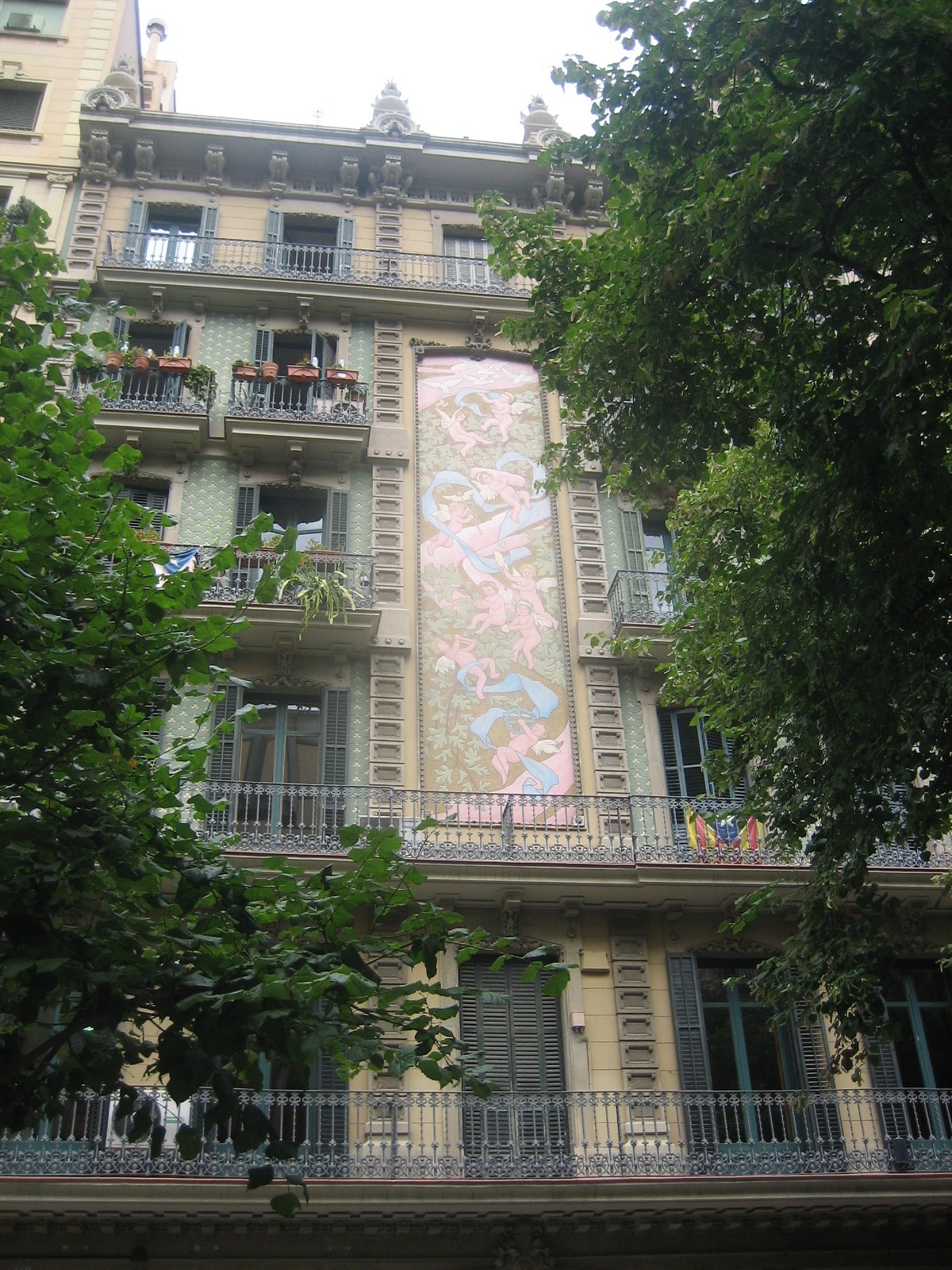
My building. There Those flags hanging from the 3rd set of balconies are for Catalán independence

This is my building and those three Juliette-type balconies on the top floor there, that’s my flat. Sadly the building is not one of Gaudi’s creations, but it certainly has modernista (art nouveau) touches. I think it’s rather pretty.

Barcelona is renowned for it’s modernista architecture so I feel quite privileged to live in a building that somewhat lives up to that reputation. Here are a few other nearby examples:


This part of the city is called The Eixample – pronounced like “eshampla”. It’s a Catalán word meaning “widening” or “extension”, which is exactly what the area was when they built it in the late 1800s and early 1900s – an extension or widening of Barcelona.

It filled in the gap between the existing city and surrounding towns, like Gràcia towards the mountains - which is why the famous shopping street Passeig de Gràcia (Gràcia Passage) is called what it is - or Sants to the south.

Of course over time, with the building of the Eixample these towns became incorporated into Barcelona itself – Sants is home to Barcelona’s main railway station – but you can still tell quite clearly that they were once separate: the Eixample’s art nouveau architecture and its distinctive road layout makes it pretty obvious when you enter or leave it.


The Eixample’s roads are long and straight and in a grid formation, very different from much of the rest of the city. But the most distinctive feature of the area is its octagonal city blocks. This means each intersection is octagonal also – a fact that completely infuriates a dear friend of mine when he visits from Madrid, for the extra walking it creates to cross each intersection.

The Eixample's grid is very obvious from the air

Closer up, the distinctive octagonal blocks stand out. You can also clearly see where the Eixample starts and stops. 
That's Gràcia on the right-hand side. Image by Alhzeiia (http://www.flickr.com/photos/ilak/3187655762/) [CC BY-SA 2.0 (http://creativecommons.org/licenses/by-sa/2.0)], via Wikimedia Commons.

But despite what my friend thinks, this design is not just to annoy him. There was method to, Idelfons Cerdà’s design “madness”: extra visibility at intersections, light and air-flow.

One of the most impressive elements of this design you can’t actually see from the street. Cerdà’s small blocks and the fact that the buildings that line them don’t go back too deep means that a big open space is created on the inside of each block. This means that even from the back of the building, plenty of light and airflow gets into your flat.

The interior view from my flat. Shame the palm trees in the middle aren't doing too well

This is quite different to the older parts of town or Madrid for that matter. There, your view from the interior of the building is often a light-well! In the centre of Madrid, where many of the big older flats have been split up into two or even three smaller ones, some of which are completely interior-facing, you can be left with very little light and absolutely no view (apart from your neighbours, of course).

These days Cerdà, the art nouveau buildings that abound in the area he designed – along with their architects, like Guadì, but many more too - and the Eixample itself have all become, quite rightly, treasures of Catalán culture and sources of pride. And the Eixample’s distinctive layout has become something of a symbol for the whole city.

The modernista Sant Pau hospital complex. Apparently it's the biggest art nouveau area in Europe. It's quite beautiful

Of course one drawback to the grid-layout, and one that Cerdà probably wasn’t thinking about in the late 1800s, is modern-day traffic. On my particular octagonal corner of the Eixample there’s a hell of a lot of it.

Now traffic noise you tend to get used to, and we have, but I do wonder just how much of that traffic I’m breathing in when I sit inside with the balcony doors open, enjoying that breeze that Cerdà had in mind with his design. If the dusting that’s required in this flat is anything to go by: a lot.

And then there are the ambulances. But I’ll let my dog Eddy tell you about that in his own words, in the video below:


But hey, that’s life in the city, no?

Friday, 24 July 2015

Hot! (¡Que calor!)...

It's hot. Really hot. Unusually hot. Not that Spain isn’t used to the heat, it’s just that it's started really early this year. Since the end of June, it's been one ola de calor (heatwave) after the other. And there was also a heatwave back in May that saw 40°C temperatures in many parts of the country. This really shouldn’t really be happening until August.

In Madrid, the temperatures have got the hosteleros (bar owners) worried. Their terrazas (outside areas) have been deserted during the day, meaning they’re losing a tonne of money – although I suspect they’d be doing a roaring trade once the sun goes down. 

More worrying is the damage to agriculture. The Galician potato crop has been decimated, as has the corn. The sea temperature in the Mediterranean has already hit 30°C in some places along the coast, which has sent the Lubina (sea-bass - a favourite here in Spain) scurrying for colder waters.

Back in Galicia, in some parts they haven’t even been able to drink tap water as the high temperatures have led to a increase in a certain sort of toxin. 

It’s the effects of cambio climático (climate change), the government has admitted.

I'm writing this post sitting in the shaded terraza of a bar with a cerveza bien fria (nice cold beer). It's a favourite way to beat the heat for me.

Writing this post with a cerveza bien fria. That's some interesting balcony furnishings in front of me

Here in BCN we've also got the beach for that - although if you're a local you'll most likely head slightly out of town for a dip. Barcelona's city beaches (like the Barceloneta) are great for a walk, jog or cycle along their wonderful, palm-lined broad walks, but swimming is mainly for the tourists.

Las Platja de la Barceloneta (Barceloneta Beach)

A good hint that there might be a lot of tourists here: the information signs are in English.
Oh and yes, you can still smoke on the beaches here

You will find some locals at Bogadell or Mar Bella beaches, but most will head out of town if they can - just a little north to places like Ocata or south to Gavá or Sitges (all of which are really easy to reach by the local trains).


La Platja de Gavá (Gavá Beach). If you're looking for a wide, kms long, sandy beach, this is a great choice

We popped down to a place not far from Gavá called Garraf the other day – it’s a gorgeous little beach lined with little wooden holiday shacks. There’s a great beach-side restaurant there too called El Chiringuito de Garraf that does a sensational paella. 

Just a bit on from Gavá is Garraf. Much smaller but very cute. Check out those little wooden holiday shacks lining the beach.

My favourite beach though is Balmins Beach in Sitges. Balmins is just a little north of Sitges’ main beaches and much more natural and relaxed - although that doesn’t mean there’s not a chiringuito (beach-side bar) right there on the sand for that cerveza bien fria when you need it.

Balmins at sunset. That's Sitges' stunning old-quarter in the background. 

Balmins is officially a nudist beach, but in reality it’s very mixed and a favourite with all sorts – young, old, gay, straight - swimsuited or not.

In Madrid, reaching the beach is somewhat more complicated, but not impossible as in the AVE (the high speed train), it's only 90 minutes to Valencia. Still, that takes a bit of planning (and it’s not exactly a cheap day at the beach), so a lot of people head to the municipal pools or the pantano (dam) for a swim.


I made the trip to the Pantano de San Juan just once. It's a beautiful spot to the south-west of Madrid - a huge expanse of water surrounded by lovely bushland. But - and it's a big but - it's dirty. Not enough bins and too much of a propensity for the punters to dump their picnic and BBQ leftovers in the bushland ruined it for me.

What I used to do most when it was hot in Madrid was head to El Retiro, Madrid’s fantastic city park. I’d lie in the shade of a gum tree (surprisingly the park is full of them) or to really knock two or three degrees off the air temperature, take a wonder through the park’s forested grottos. You’d be amazed at how much cooler it is there.

There's a surprising number of gum trees in Retiro, especially down on the lawns at the Atocha end.

Retiro has stunning woodlands right in the centre of town. 


Despite all this talk about keeping cool, I’d much rather be hot than cold. I’ve always been that way, although 8 years in London did confirm it.

Still, being so hot from so early in the year is a bit of a concern. Even more of a worry is that while one government department here is acknowledging that this heat is a result of global warming, another of that same government is cutting subsidies for renewables and even worse, is planning to introduce new taxes to penalise those who have bothered to install rooftop solar with storage capacity!

It’s enough to make you wonder if the government is suffering a bout of heatstroke from this ola de calor

Tuesday, 23 June 2015

Adiós Botella...


I love this video - and not just because its protagonists are three scary-fabulous drag queens working it in some of the most emblematic locations of my beloved Madrid. I love it because it represents to me a lot of what I admire and, as an extanjero, find so interesting about the Spanish.

In order to explain what I mean by that, I need to give you a bit of background.

Kiki Lorace and her lovely ladies of the video are welcoming Manuela Carmena, a seventy-one year-old ex-judge to the alcaldía (Mayorship) of Madrid and politely saying “bugger off” to Ana Botella (drag on left), the previous Mayor who was not actually contesting this time, and her party-mate Esperenza Aguirre (drag on right), one of the most powerful and divisive forces in Spanish politics, who was hoping to keep the city in the hands of the conservative People’s Party (PP).

The fact that Manuela is now Mayor of Madrid is a pretty big deal.

On a local level, because it brings an end to 24 years of PP rule in the Spanish capital, something I imagine most drag queens (and anyone else of a progressive tilt) is pretty happy about.

On a national level it represents something extraordinary that has happened in Spain recently: the apparent end of the two-party dominated system that has characterised Spanish politics since the transition to democracy in 1978.

Manuela is a member of a party called Ahora Madrid (Now Madrid), which in reality isn’t exactly a party, but rather a collective of left-wing parties and community organisations. Very importantly, Ahora Madrid is backed by Podemos, a new political party that has emerged with a bang of Spain’s political scene.

Here’s a pretty in depth story from the Guardian about Podemos, so I won’t go too much into it, apart from to say that the party evolved from a grass-roots movement that was, amongst other things, fed up with what they saw as the inaction of the traditional political parties to alleviate the misery that the financial crisis has wrought on the people of this country.

Spain’s second city, Barcelona, is celebrating a new alcaldesa (Mayor) too - Ada Colau. Her group, Barcelona en Comú is similar to that of Manuela and also has connections with Podemos. Colau entered public life as the controversial leader of a community group dedicated to stopping the evictions of people unable to pay their rent or mortgage.


Campaign poster for Ada Colau's successful run for Mayor of Barcelona

And in Spain’s other major cities, Podemos and other new political parties and coalitions have taken the top jobs or facilitated the changing of the guard.

The truth is, nobody really knows whether these new parties and coalitions will be stable enough to actually work, but a great many voters are obviously prepared to take the risk in the search to for something they feel is better than the traditional politics.

Now back to the video. It has always been in the best traditions of drag to be political. “Men dressing up in women’s clothing and mouthing the words to other people’s songs,” as Guy Pierce’s character says in The Adventures of Priscilla, Queen of the Desert is not just about men wanting to dress up in frocks (although I’m sure there is a lot of that). It’s also about making a statement, challenging the accepted gender roles in society and everything that that represents.

But having said, I’m finding it hard to remember any recent time when a bunch of drag queens got so excited about a political party that they bothered to make a music video celebrating it – at least one with such good production values.

Kiki & Co's excitement wasn’t an isolated incident either. Graphic designers and artists developed pro-Manuela imagery and uploaded it to social networks, taxi drivers donated the sides of their cabs for campaign posters, all manner of people organised themselves to lend their time and skills in support of Manuela.

An animated gif from an artist involved in the Madrid with Manuela collective
- a sort of unofficial campaign group for Manuela's bid to be Mayor of Madrid

It is this get-up-and-go, this ability to self-organise in the most creative, interesting and effective ways - so often with the good humour shown in the video - that I find so admirable about the Spanish. In fact, I've written about it before.

And whether or not you agree that this new politics is the way forward for Spain, or anywhere for that matter, I don’t think there is any denying that the courage and optimism it conveys, let alone its recent successes, is very exciting.

Wednesday, 15 April 2015

Spring… at last! (Primavera…¡por fin!)…

Just south of Barcelona’s El Prat airport, there is a little sea-side town called Gavá. It’s home to an impressively wide, kilometres-long beach, a fair few footballers’ villas and one of my favourite chiringuitos (beach-side restaurants), perhaps somewhat wishfully-named Kuwai.

We were there not long ago, tucking into a scrumptious lunch of grilled cuttlefish, ham croquetas and patatas bravas, while simultaneously scanning the sky to for a glimpse of the A380 due to take off any moment and carrying Mum back to Australia, when suddenly a familiar though long-absent excitement struck me: I could feel spring in the air.


What is it about the arrival of spring in the northern hemisphere that gets the juices flowing so? I don’t remember it being quite so captivating back in Australia – although having said that, I do remember a lot of relationship break-ups around this time of year, as “winter warmers” were shed for new springtime dalliances. I guess that’s biology.

Up here in colder climes, I imagine it also has a lot to do with the leaving behind of those long, dark, “dead” months. I remember in London how the first sighting of sprouting daffodils made my heart leap and the first sunny days of Spring saw the pubs empty as the punters crowded onto the footpath outside, wearing t-shirts (and sometimes even shorts) to enjoy their pints basking in the sunshine (even if it was only 12 degrees).

Of course here in Barcelona it’s not that extreme. Even in Madrid, where winter may not be as long as in London but is still pretty brutal, the only ones in t-shirts and shorts at this time of year are visiting guiris (foreigners) – and the more… er… excitable queens.

But still, the thrill is palatable.

I’m writing this post sitting in the terraza (terrace) of a local bar, not really caring that the sun is somewhat scalding my winter-bleached, follicular-challenged head.


In the park just across the road, pink and purple blossoms are filling the spaces where soon new leaves will be and on the faces of the people walking by, smiles have replaced the frowns of just a few weeks ago.


This excitement is a wonderful thing; a true recognition of and enjoyment in the change of the seasons - in nature I suppose. I’ll miss it when I finally head “home”.

Sunday, 9 November 2014

Cacerolada


Click on the audio link above. If you think it sounds like a whole lot of pots and pans being banged together, you’d be right. I took it from my balcony on Tuesday night but you would have heard something pretty similar if you stepped out onto just about any balcony in Barcelona between 10 and 10:15 every night this week after that (this page is in Spanish but the video has some good scenes of the pot-banging).

It’s called a Cacerolada or Cacerolazo (cacerola is the Spanish word for a cooking pan). It’s a form of public protest very popular in much of the Spanish-speaking world – and has even reached a few other places, like Canada.

The residents of Barcelona were banging their pots and pans together in protest to the latest set-back in their fight for a referendum on independence from Spain. Here’s a post I wrote about the Catalan push for independence the other week.

A makeshift bilboard for the Sí Sí (Yes, Yes) camp

Since I wrote that post, the central government took the referendum to the Constitutional Court, which duly froze it.  In an attempt to keep his word but not break the law, the Catalan Premier, Artur Mas, called a “proceso participatorio” (participatory process) - a sort of unofficial referendum – in which the very same questions would be asked, on the very same day (today, November 9) but with a non-binding result and without the same Catalan government involvement that an official referendum would entail.

That didn’t satisfy anyone. The independistas felt betrayed as they were not getting the true referendum they were promised. The “unionists” thought it was even worse than the referendum as it would lack the democratic guarantees of an official vote.  The Catalans who want the derecho de decidir (right to vote) but who were planning to vote to stay with Spain saw the compromise as a farce in which the only people who would bother voting would be the independistas. And the central government argued that any vote would be illegal and took this one to the Constitutional Court too, which froze it on Tuesday.

And hence all the pot-banging this week.

I can’t help but wonder if it wasn’t a tactical error on the part of the central government to go back to the Constitutional Court as it has, at least temporarily, shifted the anger away from Artur Mas straight back onto them.

The independistas and others in favour of the derecho de decidir might not have been happy with the Premier’s compromise, but they are even more unhappy, or better said angry, firstly with the Spanish government for going back to the Constitutional Court and secondly with the Constitutional Court itself for, in their minds, trying to rob them of their democratic right to have their say.

The referendum countdown clock, as it looked today, the day of the vote

And in the end, the vote has gone ahead anyway (the first vote actually being cast in a Catalan polling place in Australia!). It’s looking like the turnout has been big too - more than two million of the six million people who could have voted. Not bad for an unofficial referendum in a county where voting is not compulsory. 

The result is pretty much not in doubt: a win for the first part of the question at least: “Do you want Cataluña to be it’s own State?” And probably for the second part of the question too: “Do you want that State to be independent?”

The ballot paper

As the result is not binding, even if that prediction proves true, I won’t be needing a visa to live here any time soon. But now that the question has been asked, what comes next is going to be very interesting. All eyes are on both the central and Catalan governments to see their next moves.

A final word on caceroladas.  I took part in one once. We were demonstrating in Madrid’s Plaza Chueca, the traditional heart of gay Madrid, against moves by the Town Hall to limit the city’s famous Gay Pride celebrations.

I’ve got to say it was a lot of fun and it is quite an effective manner to protest in the sense that it does get you noticed - a relentless banging on hundreds of pots and pans simply can't be ignored.  It wasn’t so successful in stopping the limitations though and these days Madrid’s Pride is sadly a shadow of its former self. But that's another story for another post.

Thursday, 16 October 2014

A year in Barna already (Un año ya en Barna)


A year ago today we drove into a sunny, autumnal Barcelona, dog-in-tow, to start the next chapter of our lives. We were filled with mixed feelings. On the one hand, we were excited. This was the next big step for G in his career; we knew we were moving to a beautiful city; we were going to be living by the beach again; we already had some friends here waiting for us.

But on the other hand, just a day before we had said a sad goodbye to our friends and our life in Madrid. Seven years is more than enough time to develop meaningful relationships, both with people and places.

So how has this year been? Well if I’m honest, it’s been a little tough. Of course it’s never the same living somewhere as experiencing it as a tourist. But we knew that - it’s not the first (or the second) city we’ve moved to.

And it’s not like haven’t established a life here. We’ve embraced, with some relish, the substitution of Madrid’s (in)famous vida nocturna (night-life) for lovely Sunday lunches with friends on the beachfront and cocktails in stylish terrazas (roof-top bars).  I find myself savouring more than ever our walks along the tree-lined, architecturally rich grid-streets of the Eixample or through the narrow, crooked alleys and slanting buildings of the Gothic and Born districts. As I’ve mentioned previously, I’m left feeling privileged by my daily dog-walking ritual past the Sagrada Familia church. And G’s professional success over this last year fills me with pride and him with a sense of accomplishment.


No, the “problem” is not a lack of a life here, it’s that having so embraced our Spanish life back in Madrid, the move to Barcelona made us feel, quite unexpectedly, that we weren’t living in Spain any more!


Pic: assamblea.cat

Now that might sound a little crazy, but I’ve come to believe that what the Catalanistas like to say rings somewhat true: Cataluña is not Spain. Of course it is geo-politically, but culturally and socially it is quite different. And I don’t think that we were prepared for that.

So this is the reto (challenge) for our next year here: to really say goodbye to Madrid. To stop comparing our old home with our new one and just enjoy Barcelona for what it is: a shimmering jewel on the shores of the Mediterranean with stunning architecture, sensational weather and way of life and a culture that is its very own.

Monday, 29 September 2014

Cataluña or Catalunya?

The official Catalan flag - La Senyera (L) and the Catalan independence flag - La Estelada

This Saturday just gone was a “historic day” in Cataluña, according to just about every media source I read or tuned into. Of course, which sense of “historic” depended very much on the news source and, clearly, which side of the fence they sit on regarding Cataluña’s derecho a decidir (right to decide) its future within, or not, Spain.

You see, the Catalan President (Premier), Artur Mas, signed into law the Ley de Consultas – the law authorising a referendum in Cataluña on independence from Spain, that he plans to celebrate on November 9 this year.

The referendum countdown clock - installed in the Plaça St Jaume.
On the left it reads "Now is the Time"

The central government in Madrid has flatly refused the referendum on the grounds that it would be unconstitutional for Cataluña to vote unilaterally on independence. And indeed, today, the Consejo de Ministros (Spain’s Cabinet) are meeting with the sole purpose of taking the Catalan law to the Constitutional Court, which will paralyse it until a decision is made. A callejón sin salida (dead-end alley), as those opposed to the independence push say? Well, we’ll have to see.

You could say that symbolically, all the planets had aligned to bring us to Saturday’s “historic” event. On September 11, Cataluña celebrated its “national” day, La Diada”.  This day commemorates the fall of Barcelona in 1714 to the Franco-Spanish forces of the Bourbon king Felipe V at the end of the War of Spanish Succession.

The Catalans had chose the losing side in the war, but their defeat (and their resistance during the Siege of the city) ended up forging a stronger Catalan national identity - sort of like Gallipoli for Australians, I guess.

(As a side-note, I can’t help noticing that Spain’s new Bourbon king (yes Spain’s monarchs are still Bourbons) is Felipe VI… Spooky.)

One of the many huge billboards erected in the centre of Barcelona by the Town Hall,
celebrating the Tricentenary of the Siege of Barcelona. It reads "Live Free"

This year is the 300th anniversary of the end of the Siege, and with the independista fervour generated over the last year and a bit by Artur Mas’s centre-right nationalist government (supported by their political opposites in just about any other matter except the push for independence, the left-wing republicans Esquerra Republicana) the turnout for the celebrations was massive – the biggest ever. 

1.6 million people, according to the police, converged on Barcelona. Dressed in red and yellow – the colours of the Catalan flag - they took up their positions on two of the city’s main arteries, the Gran Via and the Diagonal, forming a gigantic V for Vota (Vote) that stretched for 11 km. It was quite a sight. 

Part of the V. Pic: Josep Carpintero, Asemblea.cat. CC license

(For fairness, I should note that the central government put the figure at 480,000. Here in Spain though, you generally have the absurd situation where organisers of demonstrations dramatically over-estimate attendance and the government dramatically underestimates the same, so you usually have to go for a middle figure, although in this I’m tempted to go with the police.)

More of the V. Pic: Josep Carpintero, Asemblea.cat. CC license

All this was just a week out from Scotland’s referendum on independence from the UK. The vote was followed with bated breath here in Cataluña and the rest of Spain and although the result obviously disappointed the Catalan independistas, they quickly turned it around to celebrate the fact that the Scottish were at least given the opportunity to vote.

Towers symbolising voting urns set up at the apex of the V during la Diada

And this is where I think things get a bit messy for Madrid. You see it’s not nearly as simple as to say that all those who want the derecho a decidir actually want independence. Last week, when the Catalan Parliament passed the law for the referendum, it did so with the support of more than just the nationalist parties. Many Catalan’s just want to be allowed to have a say.

As an extranjero living in Barcelona, I feel strangely removed from what is going on around me. I’m aware that I can’t fully appreciate the fear and pain that many Spaniards feel at the possibility of a break-up of their country, nor understand the deep-seated sense of “difference” that Catalans feel to other Spaniards.  Also, I come from a country that has never suffered a civil war, as Spain did just 80 years ago, the memory of which I know must be having an impact on people’s opinions on this matter, but just how I cannot fully comprehend.

But I can’t help but wonder if Madrid’s emphatic “no” on exploring avenues for greater Catalan autonomy has not created a rod for its own back, helping to bring us to where we are now.  After all, it’s human nature to baulk at being told “no”. 

Add to that the seemingly un-ending economic crisis, earlier constitutional challenges against Cataluña led by the Party currently in power in Madrid, recent central government reforms that many in Cataluña see as attacks on their language and competences, and I can see where some of the fuel for the secessionist fire might be coming from.

Having said all that, I can understand that no government wants to be the one that oversees the break-up of their country – just look at the last-minute scramble David Cameron made up to Scotland when the polls started to give the advantage to the “Yes” camp in the Scottish vote.

Problem is, simple prohibition (even when based on sound legal arguments, as it seems to be here) seldom works. And Spain should know that better than most from it’s own recent history. Franco’s brutal oppression of any sign of (non-Spanish) nationalism did very little to quell people’s ambitions – if anything it made them stronger.

Friday, 1 August 2014

Feeling privileged (Me siento privilegiado)...

The Sydney Opera House

Being a Sydney boy, I’ve always felt privileged to hail from a city that can boast a building as wonderful, iconic and unique as the Sydney Opera House. I remember always doing my best to take the bridge rather than the tunnel as I crossed the harbour on the way to work each day, just to get a glimpse of it.

Of course during the last 15 years, I’ve only had the opportunity to lay eyes on ‎Jørn Utzon’s masterpiece once in a while and then only as a visitor to Sydney-town, which always left me feeling a little wanting – I suppose removed.

But now that I am a resident of Barcelona, that privileged feeling has returned.You see, I’m lucky enough to get to see Antoni Gaudí’s Sagrada Família church just about every day, usually as I walk the dog through the two parks on either side of it.


I’m not exactly sure if I’ve yet worked out just what grabs about it: it’s impressive bulk, that somehow makes it look tall and squat at the same time; the schizophrenia of the styles of the two main facades – the gothic and naturalist of the “Nativity” or the angular and austere of the “Passion” (it's probably a little controversial to say this, but the Passion is my favorite – there’s just too much on the Nativity side for me to take in); the wonderful ceramic “fruit-bowls” that adorn the sharp peaks of the buttress; the glimmering tiles that clad the spires, the lizards and snakes clinging to the outside walls of the radiating chapel; or the simple fact that just when you think you see a part of it that seems “cathedrally” conventional, you look again and see that it is anything but.


The Passion facade - my favourite

The "fruit bowls"

The glimmering towers

The lizards and snakes clinging to the walls

Not that everyone is a fan of the Sagrada Família. A very good friend of mine visiting from Madrid told me in no uncertain terms that he didn’t like anything about it. And others, perhaps more versed in art and architecture than him have labeled it vulgar, pretentious, a circus attraction, even “the most blatant mass of half-digested moderniste clichés”. Even Cataluña-loving George Orwell, having seen the building while he was fighting with the International Brigades during the Spanish Civil War, called it “one of the most hideous buildings in all the world”.

I do get why it is polarizing (I think my description above of what I like it is explanation enough of why others might not) but I have to say I fall firmly on the side of those who love it. And then there is the inside.

If you’re ever in Barcelona and tempted to be satisfied with viewing the Sagrada Família just from the outside, resist. Do yourself a favour, brave the crowds and go inside (book your entrance online so you won’t need to line up in a queue that sometimes just about wraps around the entire block).


A forest of geometric wonder

I only saw the inside for the first time a few months ago (it was still a building site when I first came to see it in 2000) and it made my jaw drop. The sheer height of the vaults (60 meters in parts), the imposing columns of sandstone, granite, basalt and porphyry, clearly reminiscent of a forest of giant trees complete with branches and the magnificent geometric detail of the ceiling are just some of the highlights for me.

I also love the back-story of the place: the important Modernista (Art Nouveau) outbuilding that was the school Gaudi built for the children of his workers; the way Gaudi captured the forms and flows of nature for his designs using shapes suspended with string and viewed in a mirror (you can clearly see the results of that in the design of the anterior); the fact that anarchists during the Spanish Civil War burned many of Gaudi’s designs and they had to be re-created via photographs and (later) computer-aided design; or, as an engineer friend of mine visiting from Australia explained to me not long ago, that Gaudi was so far ahead of his time that we’ve had to wait for engineering technology to catch up with some of his plans in order to actually build them!

So yes, I do feel very privileged to be able to enjoy this building every day, even if only for (or perhaps because of) the mundane reality that the dog needs to have a walk and do his business.  And I look forward to returning one day in or after 2026 to see it completed – although I imagine I’ll find it a little odd minus all the cranes that are the only way I’ve ever known it and that have become, for me, part of the building.


These days, for me at least, the cranes are part of the Sagrada Família

In the meantime, thanks to the wonder of computer animation, we can get a glimpse into that future. Check out the video below: