Last week,
the New York Times published a scathing editorial about a recently passed law here
in Spain, officially called “The Law for Citizen’s Safety”, but popularly
known as La Ley Mordaza (The Gag
Law).
In the
editorial, entitled “Spain’s Ominous Gag Law”, which is well-worth reading by
the way, the New York Times opined that the law’s purpose appears to be “to help the ruling party maintain its hold on
power by discouraging the anti-austerity protests that have snowballed into
widespread support for the populist Podemos party”.
I couldn’t
agree more whole-heartedly with their assessment, although I’d even go further
and suggest that it is an attempt to quell any show of opposition at all to the
government’s policies.
As the
editorial states, the law introduces massive fines for demonstrating in certain
places: 30,000€ for demonstrating in front of government buildings, 600,000€
(yes that's five zeros) for spontaneous demonstrations in front of other places
considered “strategic”, 30,000€ for filming or photographing police and
soldiers doing stuff(!)
 |
| Police blockade at the end of my old street in Madrid. They were blocking the way in case protesters wanted to get close to the HQ of the Partido Popular, the party of the current government |
 |
| With the new law, I could very well not be able to take a photo like this, or even the one above, for risk of copping a 30,000€ fine |
I find this new law both
infuriating and terrifying. How is it possible that the government of a western
European democracy could even contemplate such a law, let alone actually implement
it? To me it reeks of something that belongs in the dark days of 1930s Europe.
The
government’s excuse for the law (as it’s name suggests) is security for its
citizens and institutions. To me, that sounds like something straight out of the propaganda chapter of “Fascism for Dummies”. It’s also utter rubbish.
For much of the time I have lived in Spain, the country has been gripped by a
relentless and brutal economic crisis that has seen general unemployment rise
to more than 26% at one point (currently it’s not much better at over 23%).
The
degradation and depravation that has accompanied this has been heartbreaking: desahucios (evictions) in their tens of thousands
resulting in skyrocketing homelessness; well-dressed pensioners begging in the
street; people rummaging through the bins to find something to eat or sell. These
are still every-day sights here.
But despite
all this, the Spanish have maintained a dignity and control that, as an extrajero, has truly impressed and astounded
me. Spaniards don’t just get mad, they get organised. Throughout 2013, there
were close to 4500 manifestaciones (demonstrations) on the streets of
Madrid alone. I was living right in the centre of that wonderful city that year and I saw plenty of them.
 |
| The placard translates to "Organise your rage". The Spanish don't just get mad, they get organised |
People demonstrated against the crisis, against the government’s responses to it
(like cuts to social services, privatisations, new labour laws), against the
seemingly never-ending corruption scandals that were bubbling to the surface just
about every day, against the foreclosures and evictions.
 |
| This 2011 protest was against the crisis in general and the capital that caused it |
 |
| This group from a Madrid 2013 protest was in support of the miners from the north of Spain. The big banner reads: "We're not just indignant, we are "up to the balls", which is a pretty strong was of saying "fed up" |
But what was
even more striking than such community organisation and action was the
lack of violence: in the vast majority (and I'm talking 90-odd percent) of these demonstrations there just wasn’t any.
That’s what makes the government’s excuse for the Ley Mordaza so unbelievable. Why, if the vast majority of demonstrations in Spain are peaceful, even carnival-like at times, do such draconian measures need to be introduced? They don’t, of course.
That’s what makes the government’s excuse for the Ley Mordaza so unbelievable. Why, if the vast majority of demonstrations in Spain are peaceful, even carnival-like at times, do such draconian measures need to be introduced? They don’t, of course.
 |
| A great many demonstrations I saw were attended by whole families... |
 |
| And all ages. The placards read: "Use of Common Sense Permitted" and "Enough with the Economic Violence" |
 |
| Although the reasons for demonstrating were serious, there was often a "carnival" atmosphere. The top photos is from 2011, the bottom from 2013 |
I believe with this law the government is attempting to squash this spirit of organisation
and action of the people. They don’t want dissent in the streets – especially
organised dissent that actually brings results.
The Marea Blanca (the White Tide) were demonstrations by Madrid health workers who managed to stop mass-privatisations in the Madrid region’s health service; the Marea Verde (the Green Tide) were demonstrations by educationalists, students and parents that have caused no end of problems to the government’s education “reforms” and, as the New York Times noted in their editorial, the 15M demonstrations actually spawned a new political party and it is seriously threatening the two-party system that has characterised Spanish politics ever since La Transitión (Spain’s transition from dictatorship to democracy) and hence the government’s grip on power.
The Marea Blanca (the White Tide) were demonstrations by Madrid health workers who managed to stop mass-privatisations in the Madrid region’s health service; the Marea Verde (the Green Tide) were demonstrations by educationalists, students and parents that have caused no end of problems to the government’s education “reforms” and, as the New York Times noted in their editorial, the 15M demonstrations actually spawned a new political party and it is seriously threatening the two-party system that has characterised Spanish politics ever since La Transitión (Spain’s transition from dictatorship to democracy) and hence the government’s grip on power.
 |
| The white coats of health workers in a demonstration of the Marea Blanca in 2013 |
 |
| Huge crowds attended many of the demonstrations, as here in Madrid's Paseo de Prado in 2011 |
 |
| The 15M (May 15th, 2011) protest camped out for weeks in the central Madrid square, La Puerta del Sol. This protest would eventually spawn the new political party Podemos. |
Spain’s democracy is young - not quite 40 years old – but I always thought it was strong. That this law is being introduced is making me question that.
What I hope is that the many people still around who
remember Franco’s dictatorship will smell the reek of authoritarianism
in this law and using their skill at organisation and action, put an end to it.
It is an election year after all.
It is an election year after all.
Some memorable pancartas (placards) I have seen at Madrid demos
 |
| No translation necessary |
 |
| "They (the politicians) don't represent us". That's the Prime Minister having unspeakable things done to him by a banker |
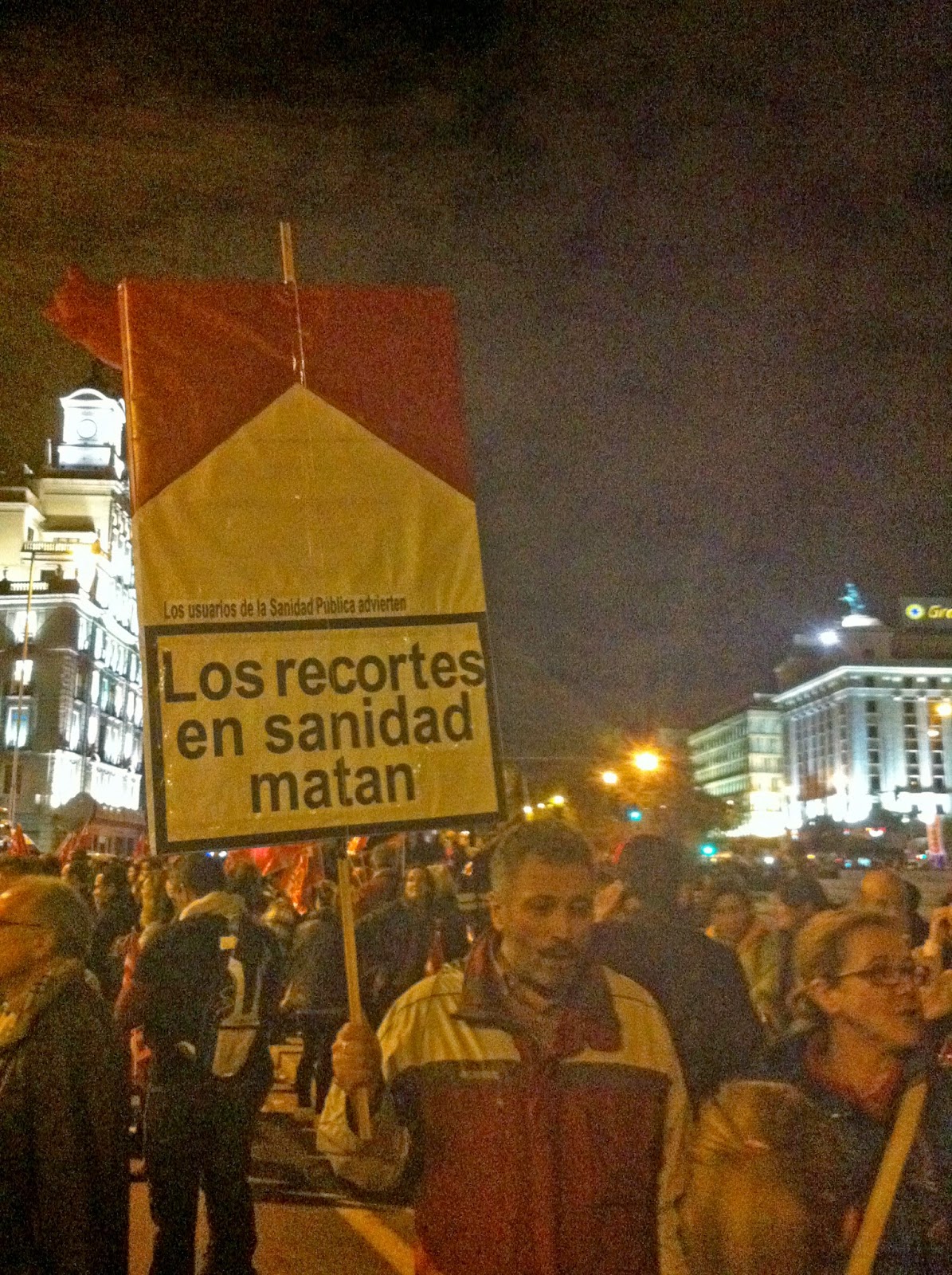 |
| Cigarette pack warning: "Cuts to Health Kill" |
 |
| The typical "For Sale" sign that people peg to their balconies when selling their flat. Here is reads: "For Sale. The Welfare State" |
 |
| The big red thing is meant to be the famous chorizo sausage. The chorizo has come to represent corruption and waste. The banner underneath reads "Looking for honourable and committed politicians. Are there any around?" |
