Showing posts with label traditions. Show all posts

Friday, 26 December 2014

Merry Christmas, Feliz Navidad, Bon Nadal...


It’s Christmas time again. I can't quite believe it's already our second Barcelona Navidad (or more precisely in Cataluña: Nadal). Even more shocking, for me, is that it’s our eighth Christmas in Spain. ¡Coño!

Today is only our second "Boxing Day" however. That’s because there is no holiday on the 26th of December in Madrid, as in most of Spain. But Cataluña is Cataluña, so for our two Christmases here, we’ve got a Boxing Day – although it’s not called that, it’s simply St Steven’s Day.

Maybe most of Spain doesn’t have a holiday on the 26th because Christmas is pretty long here - it doesn’t wrap up until after the public holiday on the 6th of January. 

That’s because on the night of the 5th, Los Rayes (literally "The Kings", but meaning the Three Wise Men) visit the homes of all good boys and girls to leave them presents – just as they did for Jesus Christ all those years ago.  

Here are some Christmas scenes from here in Barcelona.

The Pretty Lights


The Christmas Market


All the protagonists for your Belen (literally Bethlehem, but in this context it means nativity)


Gum-nuts and gum leaves are for Christmas here in Barcelona


Gargoners - literally "pooers" (look closely, they're all doing it). I've spoken about these guys before. They're a Catalan Christmas favourite.
 Traditionally it's got to do with bringing prosperity for the new year by fertilising the ground!

The Traditions


Churros. Best washed down with hot chocolate


Castañas (Chestnuts) roasting on an open fire


Lining up for La Loteria de Navidad - El Gordo (the Christmas Lottery - the Fat One)


Shopping at the market for Christmas (Eve) dinner


Checking out the Belenes in the barrio (neighbourhood). This one is in my local market.


Tio's de Nadal.  Very Catalan - you won't find these guys in Madrid. 
Underneath you leave sweets for good kids and coal for the not-so-good ones


My Cargoner. The detail is impressive (if a little gross)

Merry Christmas to all, Felices Fiestas a todos, Bones Festes a tots!    

Saturday, 1 November 2014

Trick or treating with all the saints (Truco or trato con todos los santos)…

Last night was Halloween, or like they tend to say here Halowin. The H in Spanish is silent, it’s the G that gives a similar sound, although it comes from deeper in the throat.  So an English word that starts with an H can be quite difficult for Spaniards to say, leading them to often over-pronounce the H. It’s reminiscent, although not quite as extreme, as Manuel from Faulty Towers:


Now before you get up in arms at me for poking a little fun at Spaniards speaking English, I promise I’m doing it in the best humour. Besides, I’m acutely aware of my own accent when I speak Spanish – which is a bit of a shocker - so I know I’m in no position to throw stones.

But back to Halowin. It’s become quite a thing here in Spain, as judging by the photos my friends with kids have been putting up on Facebook, it has in Australia too. I don’t remember it being that way when I was a child.

Here though, the truco o trato of October 31st is just a prelude to a much older tradition and holiday: the Día de Todos los Santos (All Saints' Day), which is today.

It’s probably the busiest day of the year for floristas (florists) and most certainly for cementarios (cemeteries). It is the day to take flowers to the graves of your loved ones, make sure all is nice and tidy and to stop for a little chat with the dearly departed.

It’s quite a sight: typically chaotic throngs coming and going and buying flowers at the myriad of flower stalls just outside the cemetery, most of which have sprung up just for the day. The stalls closest to the cemetery entrance seem the most official, becoming less so the further away you go until finally you find the dodgiest-looking venders flogging flowers of dubious origin, but much cheaper.

All ready for the big day - in Poblenou Cemetery


Just outside the cemetery gates, a less-fancy set-up (but a nice big smile)


I like Spanish cemeteries. They’re generally very well kept, filled with pencil pines and scattered with impressive, if sometimes somewhat chilling, sculptures and statues.  


The "Kiss of Death" sculpture in the Cementiri de Poblenou. 
Beautiful and someone chilling at the same time.

They’re also home to a style of internment I hadn’t seen in Anglo cemeteries: niches.
In Spain,in the cities at least, most of us live on top of each other in pisos (flats). And if you end up in a niche (which chances are you will), it's the same in death too.


As an aside, I wonder if any Almodóvar fans reading this think a couple of the photos above look a little familiar. If they do, it’s because I took them in Barcelona’s Cementiri de Montjuíc, scene of Rosa´s (Penelope Cruz) funeral in the wonderful film Todo Sobre Mi Madre (All About My Mother).

Montjuíc Cemetery is spectacular. It seems to have been carved into the steep slopes of Montjuíc, the mountain that pops up right next to the city and port, forming terrace after terrace of tombs and niches, linked by winding, pencil-pine lined roads and perilous sets of steps.


It is on one of these sets of steps that Manuela finally meets up with her long-lost, dying, transsexual ex-husband Lola in one of the climaxes of All About My Mother.  So Almódovar.

Manuela (Cecilia Roth) and Lola (Toni Cantó) in the Cementiri de Montjuíc during Rosa's funeral 
- from Pedro Almodóvar's All About My Mother

But the Día de Todos los Santos is not just about cemeteries; it is also, in typically Spanish style, about food. Just about every Spanish holiday is typified by some type of food - especially something dulce (sweet).

Depending on where you are in the country, the tradition can be different, but there is one that is somewhat common and rather perfect for the day: Huesos de Santos – literally Saints' Bones. They’re little marzipan treats that are meant to resemble the tibia bone. It's a little shocking but actually very fitting for Spain’s Catholic traditions, in which relicarios (relics - basically saints' bones and body bits) are extremely important.


The traditional marzipan treats for the day: "Saints' Bones"


Here in Cataluña there is another traditional treat – Panellets. They’re little pastries that are packed full of sugar, apparently originally designed to keep people going through the long night from All Saints' Day to All Souls' Day (November 2) during which the church bells would ring all night.


Panellets on display in the escaperate (shop window) of my local cake shop


The bells no longer go all night, thank goodness, but the Panellets, happily, live on.


Sunday, 13 April 2014

Palmones and other curious Catalan traditions (Palmónes y otras tradiciones catalanes curiosos)…


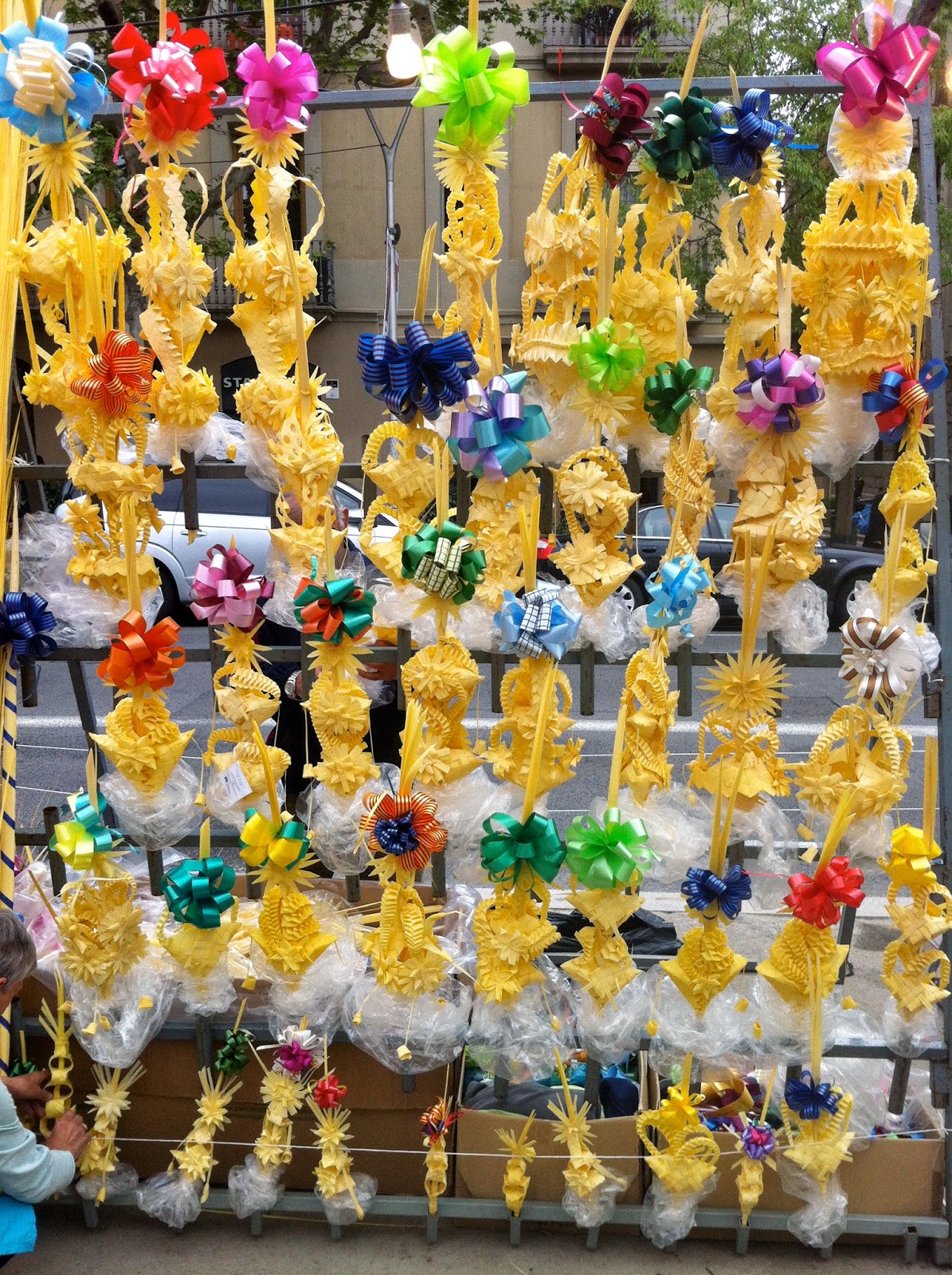
These are Palmónes. They look like sticks wrapped up with ribbon at first sight, but they are actually palm fronds – hence their name, which translates literally into “big palms”. They’re an Easter tradition here in Cataluña, and another one of the curiosities I need to add to my list of things I never saw in Madrid – like Cannelloni for Christmas and the Caganer (which I’ll get to in a minute as I cannot let that one go by without a mention).

It’s Domingo de Ramos (Palm Sunday) today, so the Palmónes are having their day. In Madrid, the (mainly) old ladies will be carrying their more regular palm fronds, minus the elaborate ribbons, home from church to tie onto their balconies.

Here in Cataluña, the Palmónes are the ambit of the kids – specifically the boys. The girls carry smaller, intricately woven versions called Palmas.  Traditionally, it’s the godparents who buy these, but I’m not sure how strictly that is being adhered to as at the Palmónes stalls just around the corner from home I saw what looked like Mums and Dads with their (excited) kids buying them together. I imagine the kids were more excited by the toys and sweets tied to them than any religious or traditional significances.

The intricately woven Palmas, for the girls

These days they use all manner of ribbons on the Palmónes and Palmas – like the Barcelona Football Club ones in the pic at the top. Traditionally though, the ribbons are in the design of the Catalan flag (red and yellow stripes).

A further Palm Sunday tradition is the donning of new clothes. If I’m honest, I can’t say whether this is the same in Madrid as I never came across it there, but here the saying goes that if you don’t wear some new clothes, your hands will fall off(!) Why exactly that is, I’ve not been able to work out…

Now, for that quick note on the Caganer – perhaps the oddest tradition I’ve come across to date. This is a figurine of someone... er... pooing. I’m serious; Cagar in Catalan means to have a poo. It’s not for Easter, but Christmas and you’re meant to pop one in a discrete corner of your nativity scene.

Traditionally they are classic Catalan peasant figures wearing a little red cap, but these days you will find all manner of characters – I’ve seen Bart Simpson, C3P0, Superman, Barack Obama, the list goes on – and all of them are squatting down and having a poo (with pile of poo included!). The true meaning of the Caganer is a bit lost, but many people say it has to do with fertilising the ground to bring prosperity for the year ahead. Whatever the reason, it’s a very curios Christmas tradition…

A traditional Caganer, pile of poo and all. Photo by Mtiedemann 

Saturday, 22 March 2014

Why I got hooked on Madrid (Por qué Madrid me enganchó)…


A while back I mentioned that my initial plan was to move to Barcelona “until I discovered Madrid”. Well, here is why that is.

I was very lucky on my first trip to Madrid – it coincided with “La Paloma” (The Dove).  La Paloma is a magical time in Madrid, when the streets of the central barrio (neighbourhood) of La Latina cram full of families, young people, old people, Chulapas and Chulapos (see below), bewildered but delighted tourists – everyone. Its roots are religious, La Paloma is a sort of patron saint of the city, but as so often happens in Madrid and Spain, the religious and the social swirl together into a whirlwind of colour, dancing, food, drink and general fun.

Chulapas & Chulapos

There is a procession: the portrait of La Virgen (the Madonna) of La Paloma is carried on high from the church where she hangs during the rest of the year, through the streets of the barrio, accompanied by the woodwind and percussion bands that mark most religious processions and led by Madrid’s bomberos (firemen) of whom she is the (unofficial) patron.  But this procession is just a couple of hours bookended by a couple of days of other festivities.

La Paloma's portrait being carried through La Latina

La Paloma represents so much of what Madrid is, and why it enchanted (and still enchants) me. Everything is full to over-flowing: the narrow streets, the typically tiny bars, the tables and chairs crammed into the squares. The noise is thunderous: patrons yelling orders at the barmen, punters in bars or in the street singing along at the top of their voices to traditional songs or trashy Spanish pop, DJs blaring tunes out into the street from the younger (or gayer) watering holes.

La Latina's streets crammed with La Paloma revellers

Madrileños are most comfortable when outdoors and in throngs. Even the solemn and haunting processions of Semana Santa (Holy Week) are massive, although strangely - eerily - quiet, affairs. Madrileños attend these processions in their thousands, year after year, to catch a glimpse of their favourite Virgen or Jesús (Jesus) pass by them, held high on staggeringly elaborate alters.

One of Madrid's many Virgens in procession during Samana Santa

The rather creepy-looking Nazarenos during Semana Santa

Being smack-bang in the middle of the country, there’s no seaside to congregate along, like in Barcelona, so in Madrid it is all about the street (or local square). And especially at night.

There is a wonderful scene at the end of Almodóvar’s film “Carne Trémula” (“Live Flesh”), where Victor, stuck in traffic and trying to get his girlfriend to hospital to dar a luz (give birth – literally “give light to”), attempts to distract his son-to-be from arriving in the taxi, by telling him about the Madrid of his birth, also on the way to hospital, at night, back in the days of the dictatorship:

“Look at the footpath full of people. When I was born, there wasn’t a soul in the street. The people were shut up in their houses, scared shitless. Fortunately for you my son, in Spain, we stopped being scared a long time ago.”

Maybe this has something to do with Madrid’s liveliness; maybe the Madrileños are making up for the 40 years they lost whilst being forced to deny their nature. Whatever the reason, these teeming nighttime streets fascinated and thrilled me from the start.  

Different urban “tribes” do favour particular barrios over others, but the segregation never feels as complete as in some other places. Perhaps it’s because the barrios are pretty close to each other, so people tend to spill from one into the other. Also, all are still home to their vecinos de toda la vida (residents who have lived there all their lives) who share their streets, squares and even bars with their new(ish) neighbours.

But if I had to generalise, the barrio demographics go like this:  Chueca for your gays, Malasaña your Hipsters (or as we call them in Spain, “Modernos”), around Sol and in Las Letras your tourists and Lavapies, an amazing mix of many: your grungier, arty/designer-types, Muslim immigrants (it was here, in the locotorios  (internet and long distance phone-call shops), cafes and curry houses that the 11-M bombings were planned), Chinese fashion wholesalers and your young gays, who have begun moving here as Chueca has got too expensive. Some friends of mine visiting from Australia a while back got themselves “lost” in Lavapies, emerging some time later in possession of some of Morocco’s rather prized export…

Chueca during Orgullo (Gay Pride)

Vecinas de toda la vida in Malasaña

And then back to La Latina. This is one of Madrid’s oldest areas - the buildings lining the narrow Cava Baja street are built on the foundations of Madrid’s ancient Moorish city wall. It rocks during Madrid’s most important festivals (like La Paloma) but the rest of the time, it’s the place to be on a Sunday afternoon, when it’s myriad tapas bars fill to overflowing with all manner of Madrileños, looking to soak up the last hours of the weekend.

Here we are again at the Madrileños love of sharing experiences. There's a timetable to living in Madrid: Saturday afternoon is un paseo (a walk) through Sol and the central shopping district, Saturday night Chueca, Malasaña or Lavapies, Sunday morning “El Rastro”, a massive flea market that has been going on forever, and Sunday afternoon, the tapas bars of La Latina. These traditions feel rather small-town-in-the-big-city (more than 4 million people live in Madrid). And it's nice. You always know where you can find the crowds, if you're in the mood.

There’s so much more to tell about life in Madrid, but it’ll have to wait for another time. For now, I hope I’ve given you a little taste of why Madrid me enganchó (hooked me) and has never has let go, even though I’ve left there… for now.