Saturday, 24 May 2014

To the Polls! (¡a las urnas!)...


This week Europeans are being called to the polls to elect a new European Parliament. It’s already started in some countries like the UK, Ireland and Holland. Spain’s turn is this Sunday, and I’ll definitely be off to place my vote.

I’m afraid I’m not going to be in the majority, however. Here they’re predicting a turnout of only about 40-45% (probably even less in Madrid where I suspect many will be too busy recovering from celebrating or commiserating the results of the other big thing happening in Europe this weekend - the final of the European Champions League - to get around to voting. You see, quite amazingly, it is being fought out by two Madrid teams: Real Madrid and Atlético de Madrid).

Football aside, people either don’t understand how the European Parliament and Commission effects them (according to recent media reports, 7 out of 10 Spaniards can’t tell you who the President of the European Commission is), are too tired to be bothered after all these years of crisis, or just don’t have any faith in politicians any more. I imagine it’s probably it’s a mix of all three.

And it’d be no wonder if the Spanish don’t quite understand the importance of these elections - there has been very little about Europe in local campaigning at all, at least from the two main parties.

The Socialists have spent most of the time complaining about some (very) machista (chauvinistic) comments made by the head of the conservative ticket and the conservatives (the Partido Popular) have spent almost all of their time rattling on about the herencia recibida (the shocking state of the economy that they inherited from the Socialists at the last Spanish general election) two years ago!

"Change Europe, Stop Rajoy."
The Catalan Socialist's very local slogan (Rajoy is Spain´s Prime Minister). 

The polls suggest that the conservatives will win Europe again. This is pretty interesting as it goes against what has been happening in most of the general elections in member states over the last few years. Not in that the conservatives are going to win – much of Europe has gone to conservative parties in recent elections - but in the sense that in general elections during this long and crippling economic crisis, most incumbent governments have been kicked out. But in Europe the conservatives have been in power for the last ten years – throughout the entire length of the crisis.

"What's at risk is the future" from the Patrido Popular. In the context of their campaign,
a clear reference to the Socialist's performance in the previous Spanish government. 

Whoever wins Spain’s share of the 751 escaños (seats) in the European chamber, you can be guaranteed they’ll be pro-European. Despite the savagery of the government’s spending cuts, most of which have been dictated by Europe, Spain is still pro-Europe.

The same can’t be said for other countries in Europe. In the UK, Holland and France, the polls are predicting some big wins for anti immigration, anti-European, anti-just-about-everything parties who have hidden none of their desire to be in the European Parliament with the sole intention of destroying the EU from within.

I’m a huge fan of the European Union as an institution – although, I have to say, not the policies and direction that those currently in power are taking the continent (I’ve probably just given away who I’ll NOT be voting for this Sunday).

I’d be a massive hypocrite if I wasn’t pro EU. I’m living here thanks to it: my dad’s Italian citizenship gave me a European passport and hence the right to live and work in the UK and now here in Spain.

But for me it goes further than this selfish perspective. The European Union has brought together counties that only last century all but destroyed the continent TWICE through war, to work for a common good and a common goal and with that has come a peace not previously known here. To me, if you’ll allow me the indulgence, it’s an earth-bound uber-prelude to Star Trek’s United Federation of Planets.

That doesn’t mean that the EU is perfect, there is plenty wrong with it - you just have to look at its inept (and arguably quite undemocratic) response to the current financial crisis to see that. But I think it’s much better to have something there to improve than nothing at all (or something whittled down to irrelevance). That’s what makes the popularity of the anti-Europe parties such a worry to me. Not to mention their unconstrained nationalism and vitriolic rhetoric, which all feels very 1930s.

Three key faces from, in my opinion, the scary side of European politics:
(L to R) Marine Le Penn of France´s National Front, Nigel Farange of the UK Independence Party & Geert Wilders of Holland's Party for Freedom.

But now, to finish, back to selfish reasons for why I’m voting this year: I’m itching to play my part in the democratic process again. I haven’t been able to vote for a government in Australia for years now (I missed the deadline to re-register one year and that cost me my right to vote there until I return) and here in Spain, unlike in the UK, as an extranjero, I can’t vote in a general election. So voting in these, probably more important than ever, European elections is just the ticket. 

¡A las urnas!

Sunday, 18 May 2014

The season kicks-off (Arranca la temporada)...


Well it seems that the season has kicked-off here in Barcelona and even though it’s early days, it is looking like our first verano (summer) here is going to be a good one.

Up 'till now, I wasn't so sure. Now I know it could almost be considered a sacrilege to say so, but I’ve got to admit to finding Barcelona a little dull our first months here. Friends reminded me that it was “winter after all”, but I suppose I had become accustomed to Madrid, whose streets are teeming (with locals) even during the cold months. I was starting to get a little worried.

It seems I needn’t have. With arrival of the first weekends of sun and warmth, Barcelona has started to fill with the air of excitement and expectation that comes with a summer by the sea.

It’s been so long since I have lived by the beach – 15 years for goodness sake – that I’d forgotten what a costal city was like. Really, it’s very similar to Sydney. Despite how good the winter weather actually is, compared to say London or even Madrid, winter is a time of hibernation for the locals. Then, as the days get longer and the sun starts to not only shine, but actually radiate heat, the winter dens are abandoned and all hell breaks loose.

Well, OK, I’m not as young as I used to be, so “all hell” is probably not going to “break loose” for me, but certainly the sangria, mojitos and caipirinhas have started to flow and helped to wash down some plentiful servings of paella and seafood at some of the fabulous chiringuitos (beachside restaurants and bars) here in Barcelona.


We’ve found ourselves at the Barceloneta a lot these last few weeks. This is downtown Barcelona’s beachside barrio (neighbourhood) that also gives its name to the beach there - although I’m not sure if many locals actually go there to swim as there are nicer beaches just a little further up and down the coast. 

The beach at the Barcelona is actually what’s left of a series of islands once off the coast, and the barrio built on land reclaimed from the sea that used to separate the two. On one side there is the old port and on the other the sea, so you actually feel like you’re surrounded by water.

Both the barrio and the beachfront are packed with bars and restaurants that fill up with tourists and locals alike. Some of the restaurants, especially on the main drag, look a little touristy to me (photo menu boards and over-eager waiters standing outside trying to hustle you in), so I’ve steered clear of them.  But we’ve found some good and fun places, and already whiled away some lovely long afternoons with friends there.

And it’s only May. Bring it on…


Sunday, 4 May 2014

Holy police merit medal, Batman!

In the news this week there was a story that perfectly illustrates how interesting a place Spain can be at times… in a bonkers kind-of-way.

Spain’s Audencia Nacional (National Court), a high Spanish court that usually tries cases of terrorism, corruption, money laundering, organized crime, genocide and other serious matters, will decide whether the recent awarding of the National Police’s highest award, la medalla de oro al mérito policial (the Police Gold Order of Merit) to a certain recipient will stand or need to be withdrawn.

La medalla de oro al mérito policial
By Heralder [CC-BY-SA-3.0-2.5-2.0-1.0 
or GFDL], via Wikimedia Commons] 

Not so bonkers so far, although perhaps a little odd that such an important court has been charged with the decision.

The case is before this court because a complaint was made by two secularist organisations against the awarding of the medal to the particular recipient, and the State Attorney, representing the government (it is the Minister of the Interior decides Police awards) refused to answer it.

Getting interesting, but still not bonkers yet.

So why is the award being questioned by the secularists? Well, the recipient is Nuestra Señora María Santísima del Amor (Our Lady Mary Most Holy of Love). A religious statue.

There you go. Bonkers.

According to the police and the Ministery, the Virgen (Virgin Mary) was awarded the medal because she shares with them values like dedication, alertness, solidarity and sacrifice.

In all fairness, the award is also for the cofradía (brotherhood) who looks after Nuestra Señora María Santísima del Amor and arranges her processions during the Semana Santa (Holy Week): La Real Excelentísima, Muy Ilustre y Venerable Cofradía de Culto y Procesión de NuestroPadre Jesús 'El Rico' y María Santísima del Amor  (The Royal, Highly Excellent, Very Illustrious and Venerable Brotherhood of Worship and Procession of Our Father Jesus “The Rich” and Our Lady Mary Most Holy of Love).

But it is she who is named as the actual recipient of the award.


Nuestra Señora María Santísima del Amor. Yes, she's a statue

To me, an extranjero from a predominately Anglican country, it does seem rather bonkers that in the 21st the government would award such a high Police honour (or any honour for that matter) to a statue – religious or not.  But for some here, it moves beyond bonkers and towards the realms of the scary.

To start with the Interior Minister, Jorge Fernandez Diaz, is a man well known for his devout Catholic faith (he is a member of the powerful Catholic sect Opus Dei) and so here could be accused of allowing those beliefs to sway his Ministerial decision-making.

But it’s more that it could be seen as a further example of how Spain’s current government has seemingly been bringing Catholicism back to the fore in the two years it has been in power.

As part of the its education reforms, religious (Catholic) studies have been brought back to state schools as a subject creditable to a students final grades and the Bishops have been given full control over the syllabus and even selection of teachers (even though those teachers are still paid for by the state). Also, the government’s planned reform to the abortion law will turn what is now a free choice for all women up to 14 weeks of pregnancy to an option that is more restricted than it was 30 years ago; something many see as both the Justice Minister forcing his religious views (he’s another very religious man) onto everyone else and also as a pay-back to the Bishops for their support of the political party of the now government during the last elections.

Whether this is the Church clawing back some of the power it wielded so widely in Spain just 40 years ago, with the help of its political allies now in government, or just a very conservative government doing their very conservative best (with a few Ministers bonkers for their faith), will depend on who you speak to.

Regardless, on June 11, Nuestra Señora María Santísima del Amor will have her day in one of the most powerful courts in the land, to find out whether she gets to keep her Police Gold Order of Merit medal after all.  

Friday, 25 April 2014

St George & the dragon, the roses and the books (Sant Jordi y el dragón, las rosas y los libros)...


This Wednesday (April 23) was all about roses and books here in Cataluña. It was La Diada de Sant Jordi (St George´s Day). The day of love (hence the roses) and Catalan culture (the books).

If you’re anything like me, you might only connect Saint George with England. But he´s actually the patron saint of many places and has been an important part of Catalan identity since at least the 14th century. The shimmering roof of Casa Batlló, one of Antoni Gaudí´s masterpieces on the Passeig de Gracia, actually represents the dragon from the legend of "Saint George and the Dragon".

Casa Batlló. The scaly, shimmering roof represents St George's dragon

Saint George and the Dragon

I was reminded that it was La Diada de Sant Jordi the moment I stepped outside my building as there was a little stall selling roses right there. Walking into the centre (my barrio is about a 15 minute stroll to Plaça Cataluña), I passed a rose stall on just about every corner (although I do have to say that some gave me the distinct impression that they may be flogging roses that had fallen off the back of a truck).


These roses I'm sure did NOT fall off the back of a truck...

But the real action was in town. Barcelona’s famous Rambla, along with The Rambla de Cataluña and the Passeig de Gracia were crammed with stall-after-stall, wrapped in Catalan flags (with varying degrees of love and care) and piled high with books or roses or both. And people. More people than I had ever seen on these streets – it took me half an hour to just walk a few blocks!


There was a very impressive number of book signings going on, a rose market in the Plaça de San Jaume and the beautiful Palace of the Generalitat (the Catalan government) was open to the public. In Plaça Cataluña, local Catalan-speaking TV stations were broadcasting live, along with Catalan radio and even Spain’s national broadcaster.

I eventually bought my rose from a stall set up by a local school. I saw others being run by bookstores and florists (obviously), clothes stores, toy stores (selling dragons, castles and Saint Georges), car dealerships, hotels, charities, animal welfare groups (including one of my favourites: SOS Greyhounds), LGBTI groups, political parties and, of course, the various Catalan independence groups.


Saint Jordi is not exactly a day for Catalan nationalism (that's La Diada Nacional de Cataluña on September 11), but with the current Catalan independence push, there was clearly an air of nationalism mixed in with all the roses and books. 

A referendum on Independence has been scheduled for the coming 9th of November. The central government has branded the referendum illegal, pledging that it won’t go ahead, but the Generalitat (currently an interesting coalition of conservative and left-wing nationalist parties) is pushing on. And so the Independistas were out in force on Wednesday, collecting signatures in support of the referendum and pushing the "Si + Si" ("yes + yes") campaign for the two questions: "Do you want Catalonia to become a State?" and in case of an affirmative response, "Do you want this State to be independent?"

"Say what Spain may, Referendum!"

If the referendum goes ahead (and that is a big "if") and the "Si + Si" campaign wins, this might have been my first and last Diada de Sant Jordi as a resident of Barcelona. You see, G and I are here as Italian citizens (my dad was Italian and G is Italian-Italian) and according to Spain and Europe, Cataluña will be kicked out of the EU if it chooses to go it alone, which could leave the huge number of resident ex-pats here from other EU countries in a bit of a limbo.

Best not to think about that for now and just smell the roses…


Sunday, 13 April 2014

Palmones and other curious Catalan traditions (Palmónes y otras tradiciones catalanes curiosos)…


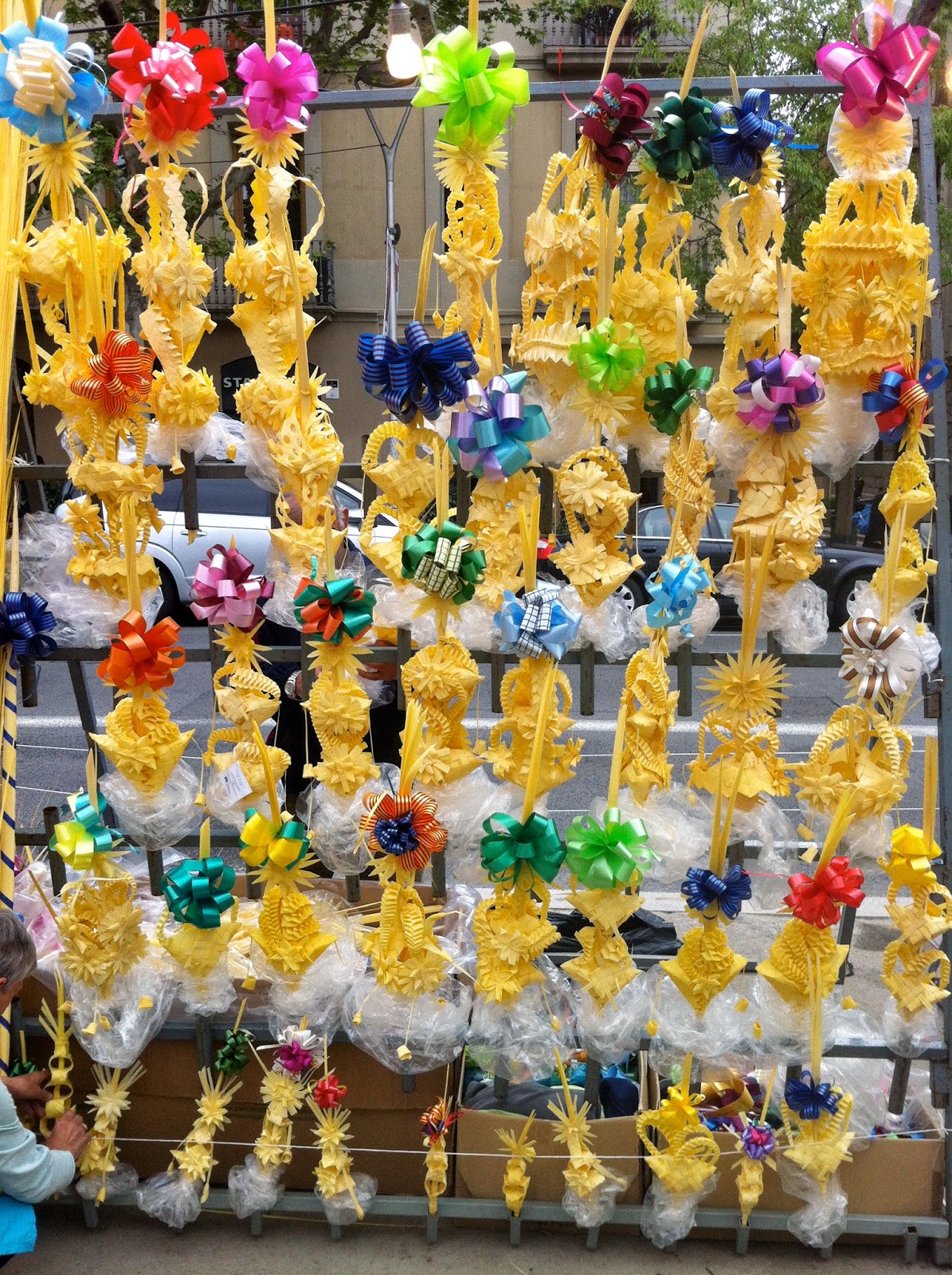
These are Palmónes. They look like sticks wrapped up with ribbon at first sight, but they are actually palm fronds – hence their name, which translates literally into “big palms”. They’re an Easter tradition here in Cataluña, and another one of the curiosities I need to add to my list of things I never saw in Madrid – like Cannelloni for Christmas and the Caganer (which I’ll get to in a minute as I cannot let that one go by without a mention).

It’s Domingo de Ramos (Palm Sunday) today, so the Palmónes are having their day. In Madrid, the (mainly) old ladies will be carrying their more regular palm fronds, minus the elaborate ribbons, home from church to tie onto their balconies.

Here in Cataluña, the Palmónes are the ambit of the kids – specifically the boys. The girls carry smaller, intricately woven versions called Palmas.  Traditionally, it’s the godparents who buy these, but I’m not sure how strictly that is being adhered to as at the Palmónes stalls just around the corner from home I saw what looked like Mums and Dads with their (excited) kids buying them together. I imagine the kids were more excited by the toys and sweets tied to them than any religious or traditional significances.

The intricately woven Palmas, for the girls

These days they use all manner of ribbons on the Palmónes and Palmas – like the Barcelona Football Club ones in the pic at the top. Traditionally though, the ribbons are in the design of the Catalan flag (red and yellow stripes).

A further Palm Sunday tradition is the donning of new clothes. If I’m honest, I can’t say whether this is the same in Madrid as I never came across it there, but here the saying goes that if you don’t wear some new clothes, your hands will fall off(!) Why exactly that is, I’ve not been able to work out…

Now, for that quick note on the Caganer – perhaps the oddest tradition I’ve come across to date. This is a figurine of someone... er... pooing. I’m serious; Cagar in Catalan means to have a poo. It’s not for Easter, but Christmas and you’re meant to pop one in a discrete corner of your nativity scene.

Traditionally they are classic Catalan peasant figures wearing a little red cap, but these days you will find all manner of characters – I’ve seen Bart Simpson, C3P0, Superman, Barack Obama, the list goes on – and all of them are squatting down and having a poo (with pile of poo included!). The true meaning of the Caganer is a bit lost, but many people say it has to do with fertilising the ground to bring prosperity for the year ahead. Whatever the reason, it’s a very curios Christmas tradition…

A traditional Caganer, pile of poo and all. Photo by Mtiedemann 

Wednesday, 9 April 2014

A ninth-century night out of town (Una noche fuera en el siglo nueve)...


The other week, G and I took a short trip out of Barcelona to spend the night in a 9th century castle. Well, the oldest part is 9th century, the rest having been added to, changed, destroyed and rebuilt over the years. Still, pretty awesome to think that we were sharing the same space where people had been living, working, flighting, held prisoner and even tortured (seriously, the anti-room to the current restaurant was actually used as a torture-chamber) over the past thousand years.


Of course to G it’s not such a big deal. He’s from Florence, so grew up surrounded by medieval wonder. But for me, coming from a country in which you’d be lucky to find a building standing that is 200 years old, it’s a thrill - even after all these years living in Europe. Not that G is a spoil-sport, he lets me ramble on about how “amazing” it is to think about all the people who had been standing in this spot or that over this century or that, feigning interest as best as he can. God bless him.


Anyway, it’s called Cardona Castle and is about an hour-drive north-west of Barcelona, in the foothills of the Pyrenees. The setting is pretty spectacular. The castle looks very imposing set up high on a steep hill overlooking the town of Cardona. From one side of the castle there are views up to the snow-capped peaks of the Pyrenees and from the other, to the jagged rock crown of Montserrat. Just behind the town you can see the reason why Cardona was once so important as to deserve a castle like this: a massive salt mountain.


Salt is still being dug out from the Cardona mine, as it has been since even before the Roman’s got there. A tour through the mine is meant to be well worth it, according to TripAdvisor. Unfortunately I didn’t read this until after we got there and we chose to visit on the only day (Monday) that the mine was closed.


There is another reason why Cardona has such an imposing castle. It used to be right on the border with Al-Andalus - Moorish Spain - so it was important for both keeping the Moors back and as a base for incursions into Moorish territory in attempts to claw it back for Christendom.  Also, being so close to France, it was important for keeping out invaders from the north. Legend has it that it was assailed a thousand times and never fell.

The mine and the castle are said to be the main things to do in Cardona, but I think a walk around the medieval town centre is essential too. It won’t take long, it’s small and when we were there at least, there was very little going on. But its narrow, hilly streets, ancient buildings and stone and wooden archways are enchanting.


There is a beautiful, austere 13th century Gothic church there too. It’s greatest treasures were a little hidden from us though as, as so happens in Spanish churches, they are tucked away in dark corners that require a Euro to be inserted into the light switch to allow you to enjoy them – and we walked into the church without a single coin between us.


The castle is these days a Parador hotel. The Paradores is a state-owned network of hotels, a great many of which occupy grand old buildings that form part of Spain’s national heritage. They were started by King Alfonso XIII (Spain's last king before the Second Republic). The idea was that by restoring these buildings and turning them into hotels they could help pay for their own upkeep, both saving them and breathing life into the Spanish countryside via tourism.


If I’m honest, I find the Paradores a little bit stuck in the 70s in terms of their offerings and styling, but the magnificent buildings that many of them are housed in I think makes us for this failing. The Spanish government is currently in the process of selling the Paradores off. This will probably update the offering, I just hope some pretty strict clauses are included for maintaining their important heritage role.

Saturday, 29 March 2014

Farewell to “the leader who changed the history of Spain" (Adiós al “líder que cambió la historia de España” )…


Spain has been in mourning this week.  Adolfo Suárez González, the first democratically elected Presidente del Gobierno (Prime Minister) after Franco’s dictatorship, died on Sunday (March 23).

Suárez was Prime Minister from 1977 until 1981, as Spain transitioned from dictatorship to democracy – what the Spanish call simply "La Transición" (The Transition).

Now, and this is probably something you'll hear from time-to-time in this blog, it completely blows me away that the country in which I am living has been a democracy for only 37 years.

I’m sure that’s because I come from a country that has only ever known democracy (at least for its non-indigenous citizens), which probably makes me a little naive. And my Eastern European friends will remind me that their democracies are even younger. But that still doesn’t dull my fascination and (even) awe.

There are some aspects of Spain that I wonder might be signs that the democracy is still young(ish). Corruption, that so flourished during the dictatorship, is still rife in the political and business worlds (although the country been getting a better handle over it just in the years that I’ve lived here); the virtually undisguised disdain which many of the powerful still hold towards ordinary people; the influence that the Church blatantly still tries to wield and the strikingly authoritarian views that often appear in the conservative media (some of the worst offenders being TV and radio stations owned by these same Bishops), are some examples.

But there are positives too. One, for me, is the fervour with which the Spanish protect their rights and freedoms. Perhaps this is because there are so many people still alive who remember living without them. I think that in some slightly older democracies, like my own, we take these rights so for granted that we can sleepwalk into them being eroded.

Spaniards on the other hand, are very quick to recognise a threat and organise themselves to fight it – often into massive movements. I’ve mentioned before the astounding number of manifestaciónes (demonstrations) that have been held in Spain since the economic crisis hit - 25,461 just last year!  And whilst it is true that most of these have their roots in the economy, many people think the measures being taken to combat the crisis are also leading to an erosion of their rights and freedoms.

There have been the mareas ciudadanes (citizens' tides) of varying colours (white for health, green for education, violet for women’s rights), movements for better democracy have camped out for months in Madrid’s central Puerta de Sol square and people have marched from all points of the country to converge into macro-manifestaciónes in the capital.

The sheer number, participation, energy, variety and (in the vast majority of cases) peaceful and festive natures of these demonstrations have been truly awe-inspiring to me, as an extranjero. Things did get very ugly just the other day though: 67 police and 34 protesters were injured when violence broke out at the end of a demonstration, in scenes like nothing I had ever seen in all the demonstrations I witnessed whilst living in Madrid (and I saw a lot of them). I hope it's not a sign of things to come…

Regardless of whether I’m right to (perhaps cheekily, or worse) suggest that these are signs of Spain’s democracy being “young”, there is no denying it is strong and modern – something that most Spaniards are very proud of.

And that takes us back to Adolfo Suárez. Just about everyone I’ve heard talk of him this week, including ordinary Spaniards, interviewed as they waited in a two and-a-half km queue for their turn to file past his coffin, agree that the road to Spain’s democracy might have been very different without Suarez and his ability to both find consensus and persuade during the very tricky time that was La Transición.

And it is for this, much more than simply being the first democratically elected PM, that Suárez was farewelled with such honours. The title of this post I’ve taken from a newspaper headline and sums up perfectly how Spain sees Adolfo Suarez: he was the man who changed the history of the country. And just 37 years ago(!)