Tuesday, 23 June 2015

Adiós Botella...


I love this video - and not just because its protagonists are three scary-fabulous drag queens working it in some of the most emblematic locations of my beloved Madrid. I love it because it represents to me a lot of what I admire and, as an extanjero, find so interesting about the Spanish.

In order to explain what I mean by that, I need to give you a bit of background.

Kiki Lorace and her lovely ladies of the video are welcoming Manuela Carmena, a seventy-one year-old ex-judge to the alcaldía (Mayorship) of Madrid and politely saying “bugger off” to Ana Botella (drag on left), the previous Mayor who was not actually contesting this time, and her party-mate Esperenza Aguirre (drag on right), one of the most powerful and divisive forces in Spanish politics, who was hoping to keep the city in the hands of the conservative People’s Party (PP).

The fact that Manuela is now Mayor of Madrid is a pretty big deal.

On a local level, because it brings an end to 24 years of PP rule in the Spanish capital, something I imagine most drag queens (and anyone else of a progressive tilt) is pretty happy about.

On a national level it represents something extraordinary that has happened in Spain recently: the apparent end of the two-party dominated system that has characterised Spanish politics since the transition to democracy in 1978.

Manuela is a member of a party called Ahora Madrid (Now Madrid), which in reality isn’t exactly a party, but rather a collective of left-wing parties and community organisations. Very importantly, Ahora Madrid is backed by Podemos, a new political party that has emerged with a bang of Spain’s political scene.

Here’s a pretty in depth story from the Guardian about Podemos, so I won’t go too much into it, apart from to say that the party evolved from a grass-roots movement that was, amongst other things, fed up with what they saw as the inaction of the traditional political parties to alleviate the misery that the financial crisis has wrought on the people of this country.

Spain’s second city, Barcelona, is celebrating a new alcaldesa (Mayor) too - Ada Colau. Her group, Barcelona en Comú is similar to that of Manuela and also has connections with Podemos. Colau entered public life as the controversial leader of a community group dedicated to stopping the evictions of people unable to pay their rent or mortgage.


Campaign poster for Ada Colau's successful run for Mayor of Barcelona

And in Spain’s other major cities, Podemos and other new political parties and coalitions have taken the top jobs or facilitated the changing of the guard.

The truth is, nobody really knows whether these new parties and coalitions will be stable enough to actually work, but a great many voters are obviously prepared to take the risk in the search to for something they feel is better than the traditional politics.

Now back to the video. It has always been in the best traditions of drag to be political. “Men dressing up in women’s clothing and mouthing the words to other people’s songs,” as Guy Pierce’s character says in The Adventures of Priscilla, Queen of the Desert is not just about men wanting to dress up in frocks (although I’m sure there is a lot of that). It’s also about making a statement, challenging the accepted gender roles in society and everything that that represents.

But having said, I’m finding it hard to remember any recent time when a bunch of drag queens got so excited about a political party that they bothered to make a music video celebrating it – at least one with such good production values.

Kiki & Co's excitement wasn’t an isolated incident either. Graphic designers and artists developed pro-Manuela imagery and uploaded it to social networks, taxi drivers donated the sides of their cabs for campaign posters, all manner of people organised themselves to lend their time and skills in support of Manuela.

An animated gif from an artist involved in the Madrid with Manuela collective
- a sort of unofficial campaign group for Manuela's bid to be Mayor of Madrid

It is this get-up-and-go, this ability to self-organise in the most creative, interesting and effective ways - so often with the good humour shown in the video - that I find so admirable about the Spanish. In fact, I've written about it before.

And whether or not you agree that this new politics is the way forward for Spain, or anywhere for that matter, I don’t think there is any denying that the courage and optimism it conveys, let alone its recent successes, is very exciting.

Tuesday, 16 June 2015

Road-trip to Italy! (¡A Italia! por carretera)

I know it’s a bit of cliché to say so, but one of the things I enjoy the most about living in Europe is the proximity to different cultures and languages.

From just about anywhere you can hop on a plane at breakfast time and by lunch be choosing (if somewhat unsurely) what you want to eat from a menu written in a different language. And what’s more, from many places you can do the same just by jumping on a train or in the car.

We did just that the other week: breakfast in Barcelona and lunch in Montpellier. I got the biggest thrill out of it. It would seem that all these years in Europe still haven’t robbed this son of an island continent of the wonder of being able to drive to another country.

500 metres to France. Driving into another country still gives me a thrill

This whole trip was actually a little longer than just BCN-Montpellier-BCN though: we were on our way to Italy. I wouldn’t drive to Montpellier from Barcelona just for lunch – it’s about a 4-hour drive, which makes it a bit of trek just for the day.

A much better choice from Barcelona is Perpignan – it’s just north of the border, two hours-drive away. We did that this Easter. It’s a very pretty little town, the centre of which is a lovely mix of southern French, Catalan and Parisian-style architecture; small enough to have a good walk around and a nice unrushed lunch before heading home.

Some views of Perpignan

But back to the Italian trip: we were off to see G’s family in Florence for the first time since we got married. A big party was being planned for us. And when I say big, I mean My Big Fat Greek Wedding-style big. G is one of 13 brothers and sisters!

The drive from Barcelona to Florence is about 14 hours or so if you do it non-stop. It’s basically all motorways – or to be more precise: Spanish autopistas, French autoroutes and Italian autostradas - so it’s not exactly a difficult drive, but unless I were in a huge rush, I wouldn’t do it non-stop.

In fact, if I were in a huge rush, I wouldn’t drive in the first place. It’s a 90-minute flight from Barcelona to Florence - and it’s cheaper than driving. We worked out that we spent about 100€ each way in tolls, around 100€ each way on fuel and, so far, 135€ in speeding fines (3 speed-camera fines in the space of just 20 minutes in France!) I say “so far” as these fines came in just the other day and only pertain to our first day of driving. I’m a little concerned.

Anyway, we weren’t in any great rush and were looking on it as a bit of a road-trip adventure. We wanted to check out some scenery, I wanted to indulge my thrill for driving between countries, and G had a whole heap of stuff he wanted to bring to his family.

The route took us past the vineyards of four French wine regions - the Roussillon, Languedoc, lower Rhone and Provence - all surprisingly different in appearance. We drove over the mighty river Rhone itself, across the top of the stunningly beautiful Cote dÁzur, past the countless monasteries and villages perched so precariously on top of Liguria’s coastal mountain ranges and skirted the white mountains of Tuscany’s marble quarries. Finally we were amongst the rolling olive groves, vineyards and villas surrounding the home of the Renaissance. A visually spectacular trip.

A cruise ship in the bay in front of the beautiful (if very touristy) village of Villefranche-sur-Mer, near Nice

Nice's old-town (Vieille Ville) reminded me a lot of Italy. This is the Cathédrale Sainte Réparate
in the Place Rossetti (which sounds Italian too)

A village perched on top of a mountain in Italy's Liguria region.
(Not a great photo as taken through the barrier whilst driving over a viaduct, but you get the idea)

All that white is not snow (which I though it was at first), it's marble. The Carrara marble quarries in Tuscany

Although you wouldn't guess it, this hill looks right-over central Florence

Driving on the motorways themselves was something of an adventure too, especially in the mountainous regions where viaduct-after-tunnel-after-viaduct carries you deep through mountains and ridiculously high across valleys. The engineering is impressive (and helps explain why these roads are not cheap to drive on) and a wee bit scary at times too as you share some rather narrow lanes with monster trucks barrelling along way too fast.

We didn’t do the whole drive in one go. We stopped for a couple of nights in Menton (not far from Nice) to soak up the beauty of the Cote d’Azur. While there we stayed off the autoroute and explored the area via the winding, cliff-hugging coastal roads that offer the most stunning views of both the beautiful villages and the blue, blue sea that gives the area it’s name.

Menton. It's the last French town before Italy, which is literally a one minute drive from where I took this photo 

The view from one of the cliff-top roads between Nice and Menton. Spectacular
If we had had more time, I would have also stopped a night or two further back to sniff around some of the wine country, as well as a night or two along the Liguria coast - Portofino or even Genoa. You could make a great trip out of that.

Portovenere, on the Liguria coast. We stopped here for lunch on the final leg to Florence (and brought some excellent pesto too)

Stunnning Florence. My dad's family actually came from here hundreds of years ago. Now I've married into another Florentine family

Although we weren’t in a rush, we were on a timetable: we had that big family party to get to. It was after all the main reason for our trip. And it was sensational too. G’s family are the most welcoming of people and they do love to have a good time – all 46 of them! I felt most welcomed to the family.

My new Florentine family. Phew!


Monday, 27 April 2015

Shutting-up The People (Callar al pueblo)

Last week, the New York Times published a scathing editorial about a recently passed law here in Spain, officially called “The Law for Citizen’s Safety”, but popularly known as La Ley Mordaza (The Gag Law).

In the editorial, entitled “Spain’s Ominous Gag Law”, which is well-worth reading by the way, the New York Times opined that the law’s purpose appears to be “to help the ruling party maintain its hold on power by discouraging the anti-austerity protests that have snowballed into widespread support for the populist Podemos party”.

I couldn’t agree more whole-heartedly with their assessment, although I’d even go further and suggest that it is an attempt to quell any show of opposition at all to the government’s policies.

As the editorial states, the law introduces massive fines for demonstrating in certain places: 30,000€ for demonstrating in front of government buildings, 600,000€ (yes that's five zeros) for spontaneous demonstrations in front of other places considered “strategic”, 30,000€ for filming or photographing police and soldiers doing stuff(!)

Police blockade at the end of my old street in Madrid. They were blocking the way in case protesters wanted to get close to the HQ of the Partido Popular, the party of the current government

With the new law, I could very well not be able to take a photo like this, or even the one above, for risk of copping a 30,000€ fine

I find this new law both infuriating and terrifying. How is it possible that the government of a western European democracy could even contemplate such a law, let alone actually implement it? To me it reeks of something that belongs in the dark days of 1930s Europe.

The government’s excuse for the law (as it’s name suggests) is security for its citizens and institutions. To me, that sounds like something straight out of the propaganda chapter of “Fascism for Dummies”. It’s also utter rubbish.

For much of the time I have lived in Spain, the country has been gripped by a relentless and brutal economic crisis that has seen general unemployment rise to more than 26% at one point (currently it’s not much better at over 23%).

The degradation and depravation that has accompanied this has been heartbreaking: desahucios (evictions) in their tens of thousands resulting in skyrocketing homelessness; well-dressed pensioners begging in the street; people rummaging through the bins to find something to eat or sell. These are still every-day sights here.

But despite all this, the Spanish have maintained a dignity and control that, as an extrajero, has truly impressed and astounded me. Spaniards don’t just get mad, they get organised. Throughout 2013, there were close to 4500 manifestaciones (demonstrations) on the streets of Madrid alone. I was living right in the centre of that wonderful city that year and I saw plenty of them.

The placard translates to "Organise your rage". 
The Spanish don't just get mad, they get organised

People demonstrated against the crisis, against the government’s responses to it (like cuts to social services, privatisations, new labour laws), against the seemingly never-ending corruption scandals that were bubbling to the surface just about every day, against the foreclosures and evictions.

This 2011 protest was against the crisis in general and the capital that caused it 

This group from a Madrid 2013 protest was in support of the miners from the north of Spain. The big banner reads:
"We're not just indignant, we are "up to the balls", which is a pretty strong was of saying "fed up"

But what was even more striking than such community organisation and action was the lack of violence: in the vast majority (and I'm talking 90-odd percent) of these demonstrations there just wasn’t any. 

That’s what makes the government’s excuse for the Ley Mordaza so unbelievable. Why, if the vast majority of demonstrations in Spain are peaceful, even carnival-like at times, do such draconian measures need to be introduced? They don’t, of course.


A great many demonstrations I saw were attended by whole families...

And all ages.
The placards read: "Use of Common Sense Permitted" and "Enough with the Economic Violence"


Although the reasons for demonstrating were serious, there was often a "carnival" atmosphere.
The top photos is from 2011, the bottom from 2013

I believe with this law the government is attempting to squash this spirit of organisation and action of the people. They don’t want dissent in the streets – especially organised dissent that actually brings results.

The Marea Blanca (the White Tide) were demonstrations by Madrid health workers who managed to stop mass-privatisations in the Madrid region’s health service; the Marea Verde (the Green Tide) were demonstrations by educationalists, students and parents that have caused no end of problems to the government’s education “reforms” and, as the New York Times noted in their editorial, the 15M demonstrations actually spawned a new political party and it is seriously threatening the two-party system that has characterised Spanish politics ever since La Transitión (Spain’s transition from dictatorship to democracy) and hence the government’s grip on power.

The white coats of health workers in a demonstration of the Marea Blanca in 2013 

Huge crowds attended many of the demonstrations, as here in Madrid's Paseo de Prado in 2011

The 15M (May 15th, 2011) protest camped out for weeks in the central Madrid square,  La Puerta del Sol.
This protest would eventually spawn the new political party Podemos.

Spain’s democracy is young - not quite 40 years old – but I always thought it was strong. That this law is being introduced is making me question that.

What I hope is that the many people still around who remember Franco’s dictatorship will smell the reek of authoritarianism in this law and using their skill at organisation and action, put an end to it. 

It is an election year after all.


Some memorable pancartas (placards) I have seen at Madrid demos


No translation necessary


"They (the politicians) don't represent us".
That's the Prime Minister having unspeakable things done to him by a banker


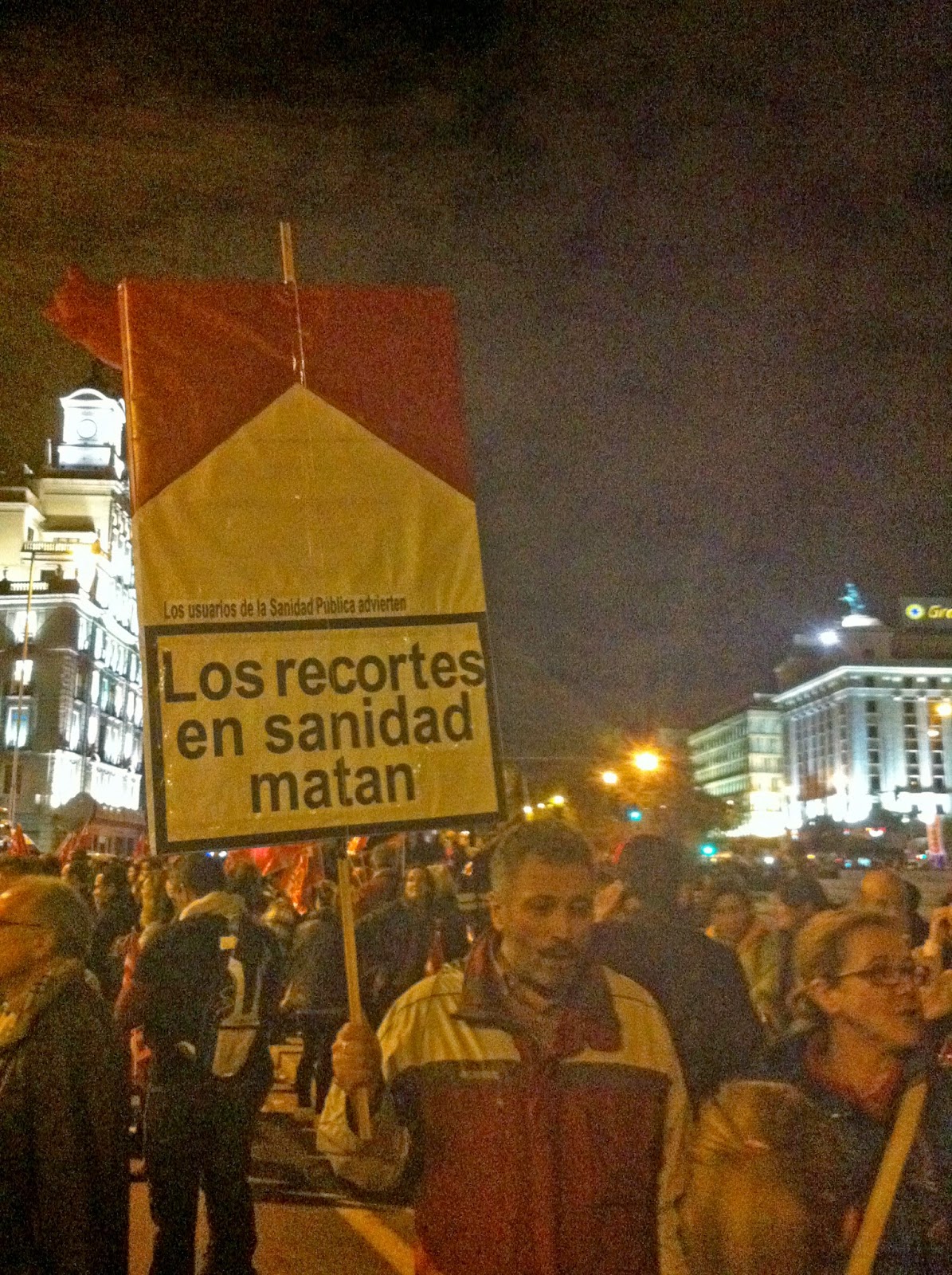
Cigarette pack warning: "Cuts to Health Kill" 


The typical "For Sale" sign that people peg to their balconies when selling their flat. Here is reads:
"For Sale. The Welfare State"

The big red thing is meant to be the famous chorizo sausage. The chorizo has come to represent corruption and waste.
The banner underneath reads "Looking for honourable and committed politicians. Are there any around?"

Wednesday, 15 April 2015

Spring… at last! (Primavera…¡por fin!)…

Just south of Barcelona’s El Prat airport, there is a little sea-side town called Gavá. It’s home to an impressively wide, kilometres-long beach, a fair few footballers’ villas and one of my favourite chiringuitos (beach-side restaurants), perhaps somewhat wishfully-named Kuwai.

We were there not long ago, tucking into a scrumptious lunch of grilled cuttlefish, ham croquetas and patatas bravas, while simultaneously scanning the sky to for a glimpse of the A380 due to take off any moment and carrying Mum back to Australia, when suddenly a familiar though long-absent excitement struck me: I could feel spring in the air.


What is it about the arrival of spring in the northern hemisphere that gets the juices flowing so? I don’t remember it being quite so captivating back in Australia – although having said that, I do remember a lot of relationship break-ups around this time of year, as “winter warmers” were shed for new springtime dalliances. I guess that’s biology.

Up here in colder climes, I imagine it also has a lot to do with the leaving behind of those long, dark, “dead” months. I remember in London how the first sighting of sprouting daffodils made my heart leap and the first sunny days of Spring saw the pubs empty as the punters crowded onto the footpath outside, wearing t-shirts (and sometimes even shorts) to enjoy their pints basking in the sunshine (even if it was only 12 degrees).

Of course here in Barcelona it’s not that extreme. Even in Madrid, where winter may not be as long as in London but is still pretty brutal, the only ones in t-shirts and shorts at this time of year are visiting guiris (foreigners) – and the more… er… excitable queens.

But still, the thrill is palatable.

I’m writing this post sitting in the terraza (terrace) of a local bar, not really caring that the sun is somewhat scalding my winter-bleached, follicular-challenged head.


In the park just across the road, pink and purple blossoms are filling the spaces where soon new leaves will be and on the faces of the people walking by, smiles have replaced the frowns of just a few weeks ago.


This excitement is a wonderful thing; a true recognition of and enjoyment in the change of the seasons - in nature I suppose. I’ll miss it when I finally head “home”.

Wednesday, 8 April 2015

Flu! (¡Gripe!)…


Last month un gripe (the flu) took hold in our household. Now I’m not talking about your run-of-the-mill “man-flu” here; I haven’t been so sick for literally years. Within the space of just a few hours I went from feeling quite normal to being worried I was actually going to die. It was brutal.

Unfortunately, despite bringing the marauding microbe home, I wasn’t the worst effected. Poor G went down like a tonne of bricks a couple of days after me and ended up in hospital with pneumonia!

That was a hell of a shock. G is normally insanely healthy - he is never sick - but all of a sudden there he was laid-up in hospital in quite a precarious state. I’m not ashamed to admit that I was pretty scared.

Now that the concern has passed (although I can tell you, we’ll both be making sure we have flu shots each year from now on), I’ve been reflecting on the whole experience from the point of view of an extranjero experiencing hospital for the first time in Cataluña.

The treatment G got once he was in hospital was actually top-notch and we’ll both always be grateful for that. But the actual getting into hospital was another story.

In Spain, the Sanidad Pública (public health service) is run by the government of each Comunidad Autonomo (literally Autonomous Community, but best translated as “Region”). As I’ve mentioned before Cataluña has privatised much of theirs.

Our local heath centre is run by one of these private companies, which also runs a hospital just around the corner from the surgery. G ended up in that hospital after our local GP took one listen to his lungs and referred him straight there with a little note saying pneumonia was suspected.

Now I thought that with such a note he’d be taken straight into one of those urgencias (emergency-room) cubicles from where all necessary tests would be performed. Instead, what he endured was seven hours of being shunted from the rickety wooden benches of the waiting room (which was actually the drafty corridor of a building from the century-before-last) to each hospital department and back again to wait the hour or two for the results from each test.

When “one last” x-ray was suggested, “just to make sure”, I put my foot down. I told the doctor that G simply couldn’t be expected to spend another few hours in that corridor – what he needed was to be at home in bed. That’s when she told us that he’d not be going home that day, but instead would be ingresado (admitted to hospital).

What followed was a 20-odd hour wait (thankfully though, now in an emergency-room bed) for a bed on the ward. Urgencias is a pretty awful place to be trapped for the best part of a day and night. To make matters worse for G (and for me), I was only allowed to see him for about 10 minutes during those more than 20 hours.

Like I said, once he was in hospital he was really well looked after, and although the building certainly looked the 100-odd years it was, it seemed to have up-to-date equipment and facilities. I just couldn’t help being suspicious that things could have been better if the hospital hadn’t been run by a private, for-profit company.

Why did G have to spend so long in the emergency department when there was a huge, brand-spanking new hospital less than a kilometre up the road? Was it because that hospital was run by a different health provider and our hospital would not get the money from the Sanidad for his three days in hospital if they sent him up there?  

Of course, maybe all the hospitals were colapsado (overrun) that day. Maybe it was the result of the cuts to the health budget because of the crisis. Maybe it’s always been that way here in Cataluña.

Or maybe my “pinko-poofo” prejudice against privatising essential services was colouring my thinking. Indeed there have been plenty of news stories this winter of emergency departments in totally public-run hospitals in other Comunidades leaving people on gurneys in corridors for 30 hours or more.

But then again this is Cataluña, where for much of the last 30 years successive centre-right governments have been busy privatising public services more than anywhere else in Spain.

And despite the savings and efficiencies that privatisation is meant to provide, Cataluña is one of the Comunidades in which public service budget cuts during this crisis have been most acutely felt by its citizens and where, at the same time, public debt has grown more than just about any other.  It’s food for thought.

But credit where credit is due. Thanks to the care that G received once he was finally ingresado  he made a full recovery - and just in time for our wedding(!) But that’s a post for another day.

Wednesday, 18 February 2015

Getting married (Nos casamos)...


This is the business end of what could best be described in English as a marriage licence - our marriage licence. Yes, we’re getting married.

It’s all very exciting, but it’s been quite a process that has taken the better part of two years and challenged patience and sanity along the way – and we’re not married yet.

The reasons for this are varied. Some have to do with this being a same-sex marriage - although that's not an issue at all here in Spain - but mostly it comes down to the particularities of our situation and the mountains of bureaucracy that you have to swim through to do just about anything in Europe.

To tell this tale correctly, I’ll start at the beginning.

I’d been bugging G for some time about the old marriage thing. He’d always been pretty lukewarm on the whole idea. Then a few New Year’s back we went to Stockholm.

One of the must-sees on any visit to that lovely city is the wonderful, somewhat architecturally-schizophrenic Stockholm City Hall. On a tour of the place, we entered a beautiful room that the guide explained was the wedding room, where anyone, “girls and boys, girls and girls or boys and boys from just about anywhere” could make their vows. That got G thinking.

A couple of months later he forwarded an EMAIL to me from the Stockholm City Hall confirming our wedding booking there. That was his proposal. Needless to say I didn’t respond. 

Getting all the paperwork together was a little daunting. We needed birth certificates, no impediment to marriage certificates, civil status certificate for G, divorce certificate for me and they had to come from all over the world: Italy, Australia, even Canada.

The bonus though was that this paper trail was a LOT less intensive than if we were doing the deed in Spain (I’d quietly done some research on getting married in Spain some time before – as I said, I had been keen on the idea for some time).

We managed to get everything together and then it all fell spectacularly apart. You see Sweden, as progressive as it might be, is a real stickler for the rules and we had run into a snag – well two snags. This is where the same-sex issue came into play.

Firstly, Italy would not provide a no-impediment to marriage certificate for G as same-sex marriage is expressly forbidden in their Constitution (thanks to Mr Berlusconi). Instead they gave him another document, saying it would be accepted. It wasn’t.

Secondly, Australia, who actually were brilliant despite not having marriage equality either, had removed the line from my no impediment to marriage certificate that stated “in Australia marriage is a union between a man and a women”, or something to that effect, in an attempt to not cause confusion for a same-sex union. Unfortunately, for Sweden, removing that line made the certificate inadmissible.

And that was that. Guttered. And just a little bit disillusioned too. But at least Sweden had got G around to the idea of marriage, and I wasn’t going to let that go. We’d do it at home in Spain.

As I said before, the paper trail for getting married in Spain is much more involved than in Sweden. The good news, though, was that the Spanish had sorted out the technical hurdles that had snookered us up north.

In case any extanjeros reading this are thinking of getting married in Spain, here’s a bit of a run-down of what needed to be organised (based on our experience of course):
  1. Birth certificates, for some unknown reason, cannot be more than one year old at the time of filing. That meant new documents for both of us.
  2. No impediment to marriage certificates, or their equivalent (in the case of G) cannot be more than six months old at the time of filing.
  3. In case of divorce the original marriage certificate is also needed (again for some unknown reason) as well as divorce certificate.
  4. All documents from countries that are signatories to the Hague Convention (Italy and Australia are) need to be authorised with the Hague Convention Apostle (stamp), which can only be done in the country of origin.
  5. Any documents from countries that are not signatories (like Canada in the case of my divorce certificate) have to be returned to that country for authentication by both that county’s Dept of Foreign Affairs and the Spanish Consul General there.
  6. All foreign documents have to be translated into Spanish by an official, government-registered translator (Sweden accepted all languages).
  7. Certificates of empadronamiento – in Spain you have to register your address with the local town hall. – going back two years, but not more than 3 months old at time of filing (work that one out). I still haven't been able to work out what would happen if one of the parties was not a resident.
  8. Passport and/or identity cards.

Needless to say all of this took some coordinating. And it was not helped by the fact that the information on the government website was not actually correct! We found this out when we had collated all the documentation and went to present it at the Registro Civil (Births, Deaths & Marriages) and they told us, completely straight-faced: "Oh no, you can't trust what's on the website".

But after some to-ing and fro-ing (and the re-issue of some documents that had expired according to their guidelines) we got there in the end. And I have to say, although getting married in Sweden would have been fun and a bit exotic, I’m rather happy that we’re doing it in the country that has been our home for all these years.  

Not to mention that the delay means that we’re getting married in the year in which we’ll celebrate our 10th year together - and that’s rather romantic actually.


A little bit about Marriage Equality in Spain

This July marks the 10th year that Spain has had marriage equality - and society hasn’t fallen apart yet, despite what is being argued in some other countries. In fact, very few people seem to give two hoots about it here.

That doesn’t mean there haven’t been challenges. The party that is now in government took the law to the Constitutional Court when it was introduced, obviously back when they were in opposition. Just a year or so ago (yes it took that long for the case to be heard) the Court threw the challenge out, saying there was nothing unconstitutional about it at all.

The ruling still didn’t stop the zealously Catholic Interior Minister say he didn’t care what the Court said, same-sex marriage was not marriage, as far as he was concerned for these reasons. I thought that was a very inappropriate thing for a senior government minister to say about a ruling from the highest court in the land. 

But hey, his blinkered opinion won't change the law. And despite the very conservative nature of the government he is a part of, barring a cataclysm, marriage equality is here to stay in Spain. There is just no appetite for change amongst the vast majority of the electorate.

Which makes me wonder: if a predominately Catholic country like Spain, still in love with so many of it’s Catholic traditions and rituals, can live so well with marriage equality, what is stopping other countries, like my own Australia, from embracing it?

Friday, 26 December 2014

Merry Christmas, Feliz Navidad, Bon Nadal...


It’s Christmas time again. I can't quite believe it's already our second Barcelona Navidad (or more precisely in Cataluña: Nadal). Even more shocking, for me, is that it’s our eighth Christmas in Spain. ¡Coño!

Today is only our second "Boxing Day" however. That’s because there is no holiday on the 26th of December in Madrid, as in most of Spain. But Cataluña is Cataluña, so for our two Christmases here, we’ve got a Boxing Day – although it’s not called that, it’s simply St Steven’s Day.

Maybe most of Spain doesn’t have a holiday on the 26th because Christmas is pretty long here - it doesn’t wrap up until after the public holiday on the 6th of January. 

That’s because on the night of the 5th, Los Rayes (literally "The Kings", but meaning the Three Wise Men) visit the homes of all good boys and girls to leave them presents – just as they did for Jesus Christ all those years ago.  

Here are some Christmas scenes from here in Barcelona.

The Pretty Lights


The Christmas Market


All the protagonists for your Belen (literally Bethlehem, but in this context it means nativity)


Gum-nuts and gum leaves are for Christmas here in Barcelona


Gargoners - literally "pooers" (look closely, they're all doing it). I've spoken about these guys before. They're a Catalan Christmas favourite.
 Traditionally it's got to do with bringing prosperity for the new year by fertilising the ground!

The Traditions


Churros. Best washed down with hot chocolate


Castañas (Chestnuts) roasting on an open fire


Lining up for La Loteria de Navidad - El Gordo (the Christmas Lottery - the Fat One)


Shopping at the market for Christmas (Eve) dinner


Checking out the Belenes in the barrio (neighbourhood). This one is in my local market.


Tio's de Nadal.  Very Catalan - you won't find these guys in Madrid. 
Underneath you leave sweets for good kids and coal for the not-so-good ones


My Cargoner. The detail is impressive (if a little gross)

Merry Christmas to all, Felices Fiestas a todos, Bones Festes a tots!